PALM BAY, FL (The Palm Bayer) — Imagine an employee walking into work only to be told that two-thirds of their salary will disappear overnight. That scenario is not hypothetical. It is the fiscal reality now moving toward the City of Palm Bay.
The Citizens’ Accountability Task Force (CATF) convenes this Monday, August 3 at 6:00 PM in Palm Bay City Hall to formally address the financial implications of Florida’s proposed Amendment 3. The meeting is open to the public. For the first time, residents have direct access to the specific local revenue projections attached to this statewide ballot measure.
A note on format: this coverage intentionally departs from The Palm Bayer’s standard short-form video summary. Amendment 3 is too consequential, and the public understanding of it too shallow, to compress into a 90-second recap. The accompanying video is the most substantive element of this piece, a full explainer built specifically to walk residents through the budget mechanics, the revenue projections, and the service tradeoffs that no one else is breaking down at the local level. The article below serves as supporting reference.
Download the Full Agenda Packet (PDF) — The complete August 3, 2026 CATF Agenda Packet, including all ZenCity survey data, state revenue estimates, and the Lee R. Feldman memorandum.
Dismantling the Homestead Exemption Structure
If passed by a 60 percent supermajority, Amendment 3 would trigger a significant overhaul of Florida’s homestead exemption structure. The measure targets the second property exemption applied to non-school taxes, which serve as the primary funding mechanism for city and county daily operations.
For permanent resident homeowners, this exemption rises to $150,000 in 2027 and $250,000 in 2028. Starting in 2029, that $250,000 baseline ties to the Consumer Price Index and adjusts upward for inflation annually, without requiring legislative approval at any level of government.
The amendment also removes the standard $25,000 exemption from municipal tax levies, limiting it to school-assessed values only. It reduces the annual taxable growth cap on commercial and non-homestead properties from 10 percent to 5 percent. Non-permanent residents receive a temporary $50,000 exemption for four years before qualifying for the full permanent resident discount.
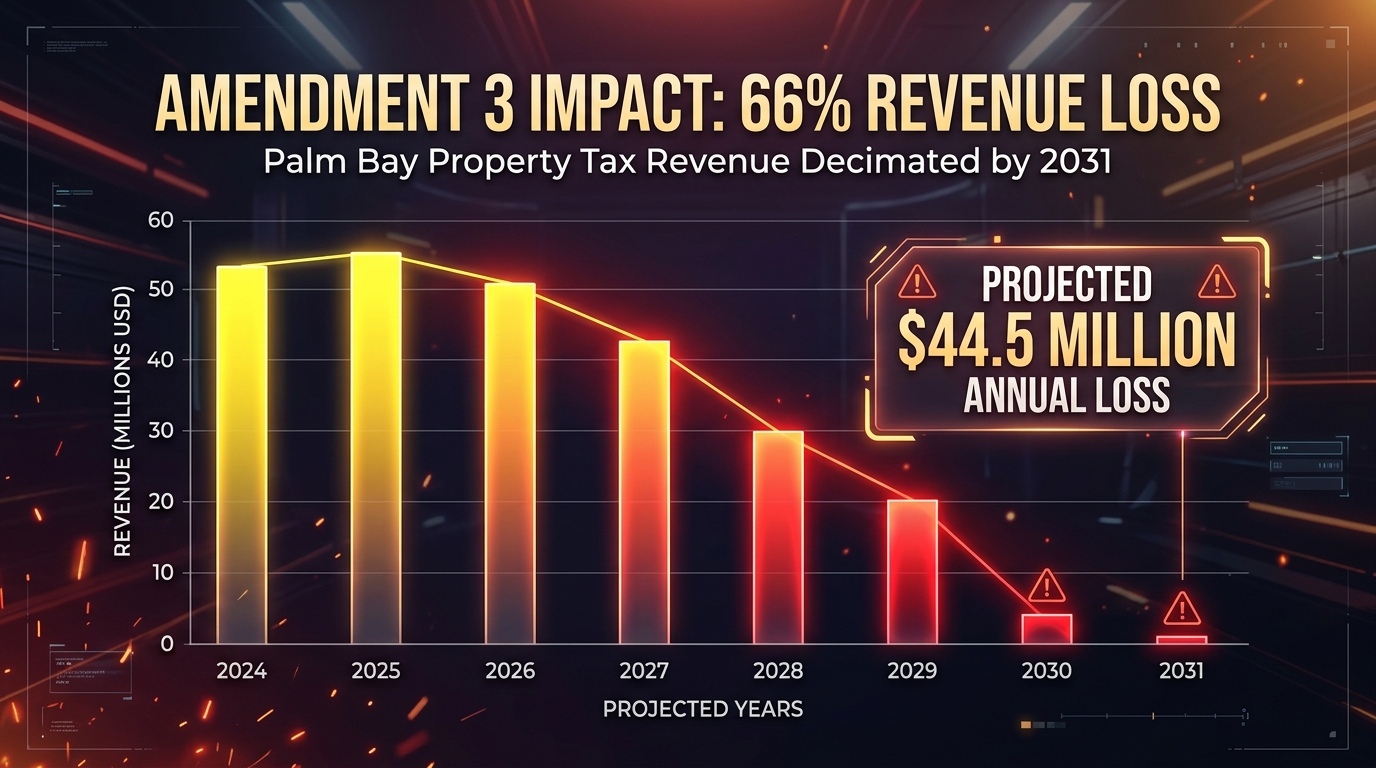 Source: State of Florida Revenue Estimating Conference Impact Statement, July 10, 2026. Projects Palm Bay’s annual property tax revenue loss under Amendment 3.
State revenue models project an initial $22 million loss for Palm Bay in fiscal year 2027, representing roughly one-third of current property tax collections. By 2031, that figure grows to a recurring $44.5 million annual shortfall, effectively eliminating 66 percent of the city’s ad valorem revenue base.
The 10-Mill Constitutional Ceiling
A common assumption during local budget shortfalls is that a city council can raise tax rates to compensate. Florida’s constitution forecloses that option here. Article VII, Section 9 caps municipal operating millage at 10 mills, where one mill equals one dollar of tax per $1,000 of assessed property value.
Palm Bay already operates near that ceiling. The city cannot legally raise rates enough to offset a 66 percent revenue loss. The state is mandating a sweeping local tax cut while providing no corresponding relief mechanism for municipalities absorbing the impact.
Decoding the ZenCity Survey Priorities
When faced with unavoidable revenue reductions, which services should get cut first? A ZenCity statewide survey of 602 residents attempted to answer that question. The top result: economic development and business attraction, chosen by 40 percent of respondents. Code enforcement followed at 31 percent, and planning and zoning at 28 percent.
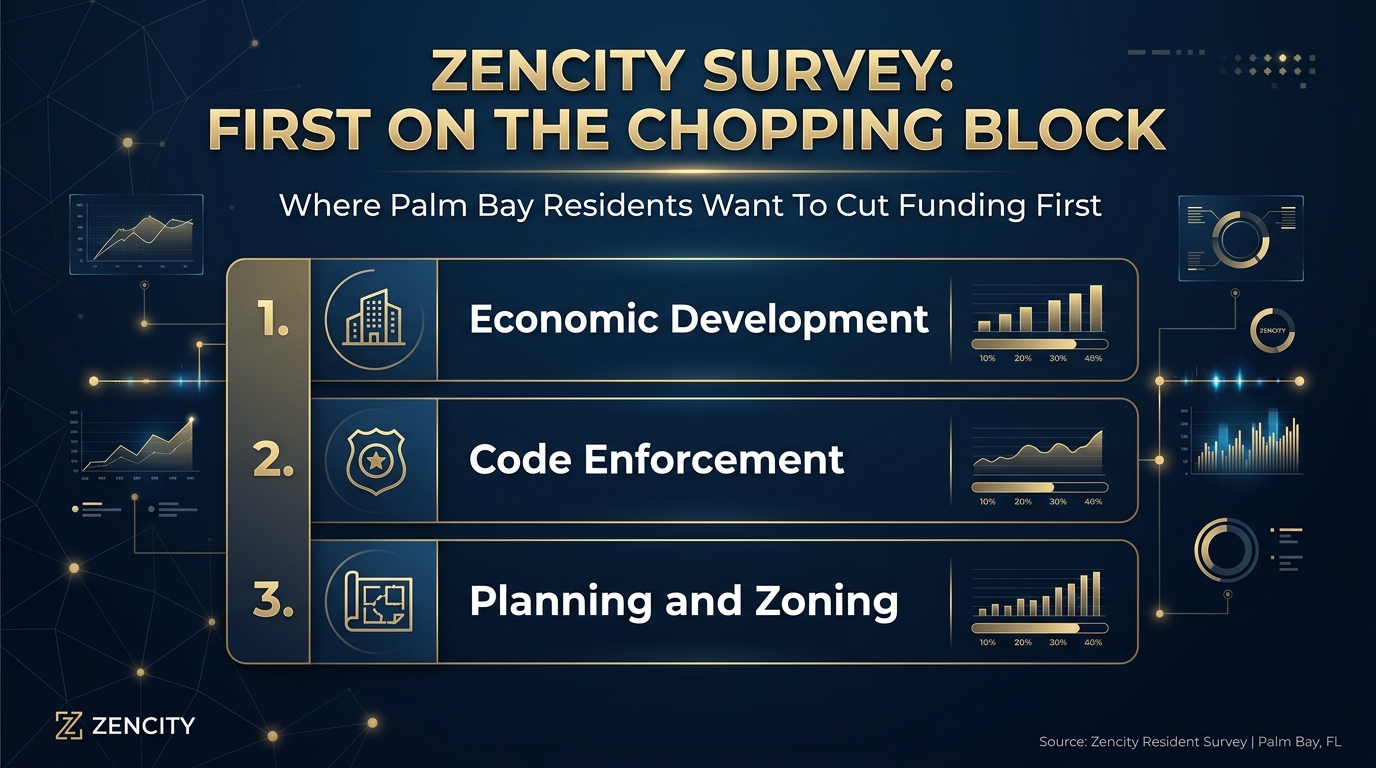 Source: ZenCity Statewide Resident Survey, June 2026. Results reflect 602 respondents across Florida.
That preference creates a compounding problem. Economic development is the primary mechanism a city uses to grow its commercial tax base, which is largely unaffected by homestead exemptions. Eliminating those departments significantly heightens long-term insolvency risks by removing the city’s most viable path to revenue recovery.
By contrast, residents strongly protected senior services, stormwater, solid waste, and public safety. Those departments received single-digit support for reductions across the board.
The Jurisdiction Misconception
The survey also revealed a significant disconnect between voter expectations and jurisdictional reality. Mosquito control and public libraries each received 22 percent support for cuts, placing them in the top five targets identified by respondents.
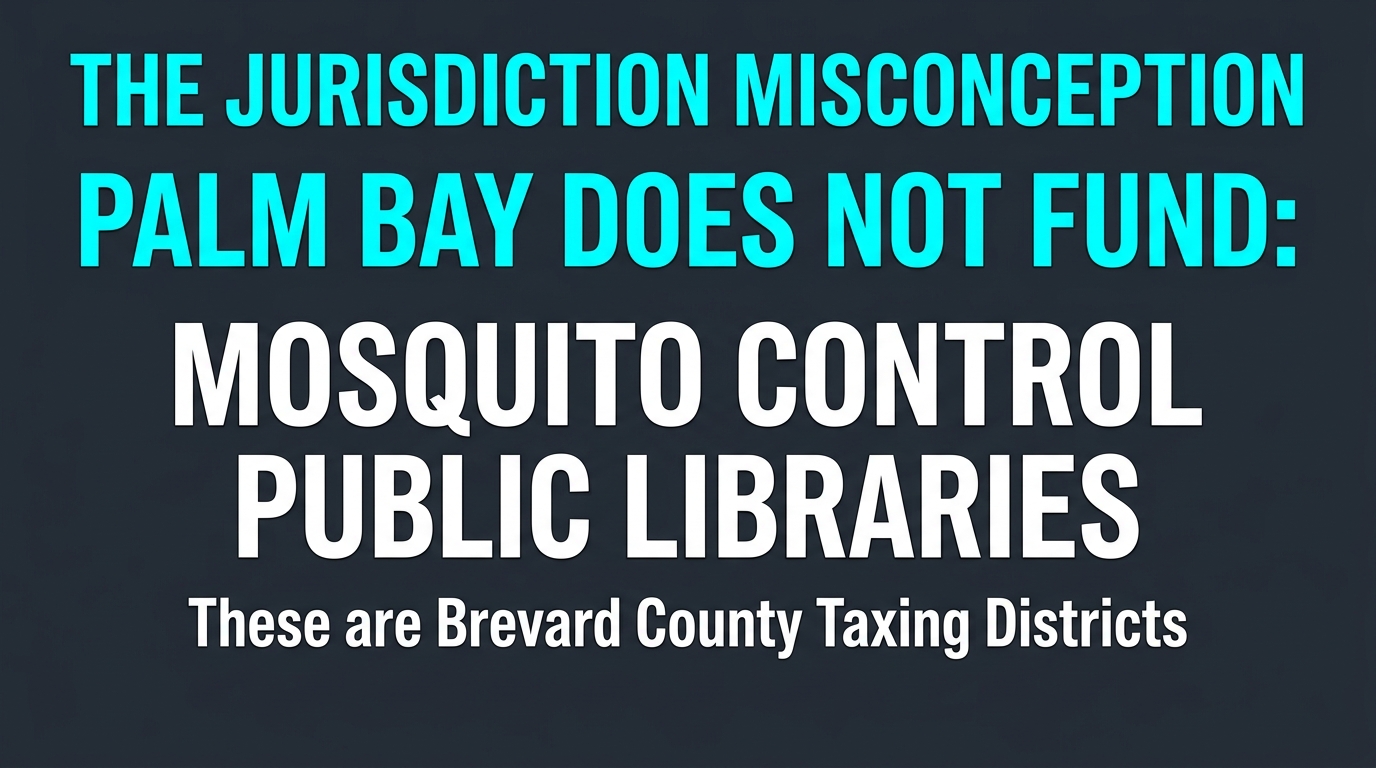 Source: August 3, 2026 CATF Agenda Packet. Illustrates which services fall under City of Palm Bay versus Brevard County jurisdiction.
The City of Palm Bay does not operate or fund either of those services. Mosquito control and public libraries are managed by separate Brevard County taxing districts. Cutting them has no effect on the city’s budget deficit. This gap between perception and jurisdiction is one of the core challenges the CATF will need to address in any public education effort.
The Affordability Paradox for Renters
The survey data surfaced a political paradox at the heart of Amendment 3. Among renters, 63 percent reported anxiety about property taxes pricing them out of their homes, a higher share than the 56 percent of homeowners who expressed similar concerns.
That anxiety is grounded in basic economics. Landlords routinely pass property tax increases through to tenants in the form of higher rent. But the amendment’s homestead exemptions apply only to permanent resident homeowners. Renters receive no direct benefit.
 Source: ZenCity Statewide Resident Survey, June 2026. Reflects respondents’ top housing cost concerns by tenure type.
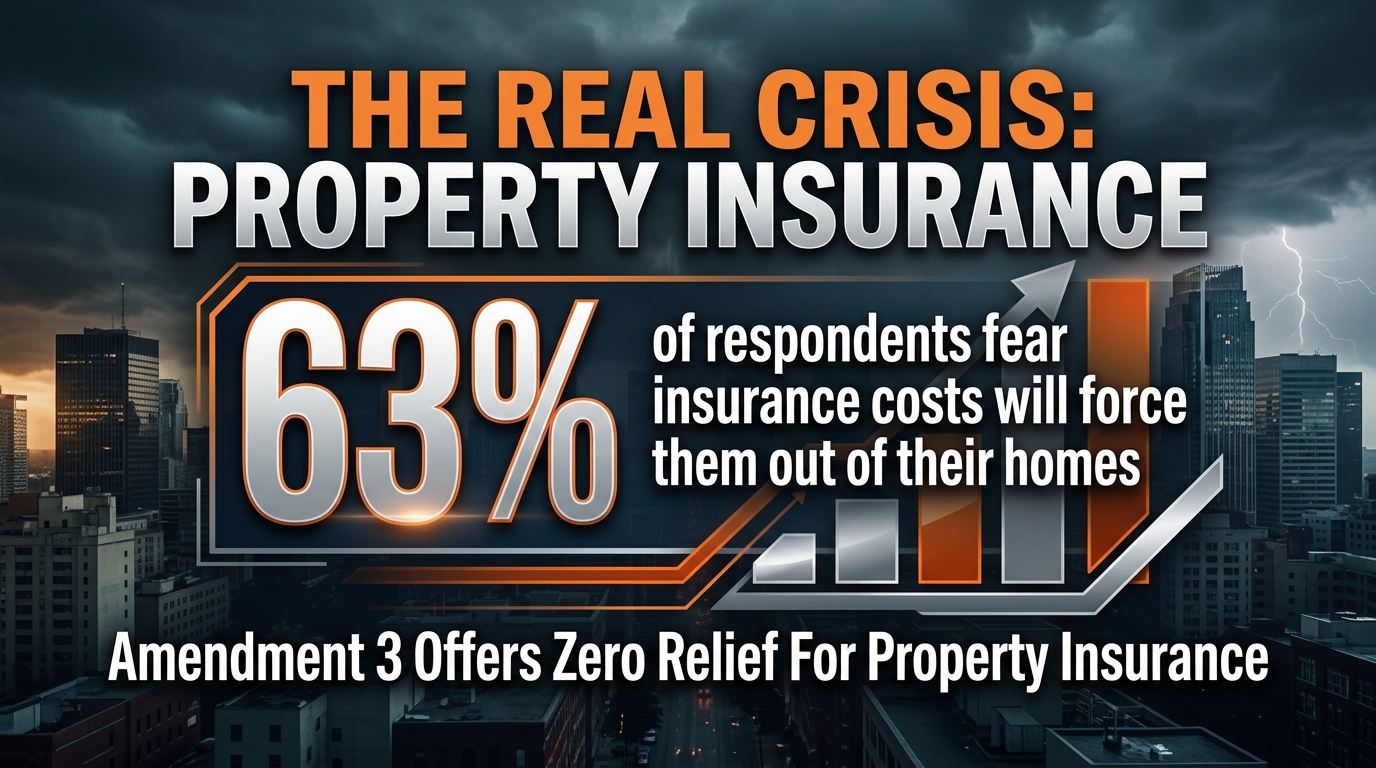
There is also no provision in the amendment addressing property insurance, a separate but related pressure point. Sixty-three percent of all respondents, and 70 percent of seniors specifically, cited rising insurance premiums as a threat to their housing stability. The ballot measure does not touch the insurance issue.
Task Force Mandate and the Path Forward
These competing pressures land directly on the Citizens’ Accountability Task Force. The CATF is charged with evaluating the financial implications of Amendment 3, educating the public on the tradeoffs, and identifying a viable path forward for Palm Bay’s budget.
If two-thirds of the city’s ad valorem revenue is permanently reduced, the options left are limited: new special assessments, increased utility taxes and user fees, or deep service cuts that reshape how the city functions day to day. The August 3 meeting is the first formal step in working through those choices.
Attend the Meeting. Stay Informed.
The August 3 CATF meeting is open to all Palm Bay residents. Doors open at 6:00 PM at Palm Bay City Hall. This is a direct opportunity to hear the fiscal projections firsthand and ask questions of the task force members working through this issue.
As Amendment 3 moves closer to the November ballot, The Palm Bayer will continue tracking its progression and the real-world impact it stands to have on daily life for Palm Bay residents, from public safety response times to road maintenance and beyond. Subscribe to stay ahead of the story.
This story is also published at The Palm Bayer.