PALM BAY, FL (The Palm Bayer) — On Wednesday, September 9, 2026, at 6:00 PM, the Palm Bay City Council will convene Special Council Meeting 2026-24 for the first of two statutory public hearings on the city’s proposed $457.3 million budget for Fiscal Year 2027.
Every September, City Hall follows a familiar script. The administration presents an austere ledger, points to structural deficits, warns that reserves must be tapped, and proposes reductions to high-visibility community amenities. For residents listening to the discussion from the dais, the presentation can make municipal finances sound dire.
The broader financial picture tells a much more reassuring story: the sky is not falling.
Palm Bay remains financially sound, with substantial reserves, a rapidly expanding tax base, and a history of prudent year-end cash management. What residents and council members are navigating is not an insolvency crisis, but an annual budgeting ritual where conservative paper projections intersect with rising fixed obligations.
Residents who wish to inspect the line-by-line figures can examine the complete 98-page City of Palm Bay FY 2026-2027 Proposed Operating Budget Line-Item Detail. Looking closely at the internal ledger allows taxpayers to separate routine administrative positioning from the genuine structural issues facing the city, understand where their tax dollars are going, and participate effectively in Wednesday night’s public hearing.
The Public Safety Ledger: Badges vs. Legacy Debt
City administration notes that Public Safety accounts for $76,581,422, or 56.4% of the city’s $135.8 million General Fund. That figure combines $40,914,695 for the Palm Bay Police Department and $35,666,727 for Palm Bay Fire Rescue. Officials often highlight this majority share when explaining why discretionary programs across other departments face constraints.
To understand that number, residents must distinguish between active emergency operations and past retirement liabilities.
An examination of department line items reveals that $15,876,267, representing 20.7% of all public safety spending, consists of legacy pension and retirement obligations. Pure defined benefit pension contributions alone account for $15,318,684: * Police Defined Benefit Pension (Account 001-5010-521.22-11): $7,913,748 (with additional ICMA and retirement lines bringing total police retirement funding to $8,260,536, or 20.2% of the police budget). * Fire Defined Benefit Pension (Account 001-6012-522.22-11): $7,404,936 (with additional ICMA lines bringing total fire retirement funding to $7,615,731, or 21.4% of the fire budget).
Actual frontline operational public safety across both departments totals $60,705,155. This is the funding that pays for active patrol officers, detectives, firefighters on engines, paramedic responses, emergency medical equipment, fuel, fleet maintenance, 911 communications personnel, and neighborhood station operations. The remaining $15.9 million does not buy patrol cruisers or put more first responders on the road. It fulfills legal, contractual retirement obligations earned by past personnel.
The primary cost pressure in this year’s budget is the sharp increase in those retirement contributions. In FY 2025, combined defined benefit pension contributions totaled $8,020,404. In FY 2026, they rose to $11,003,457. In the proposed FY 2027 budget, they jump to $15,318,684. That is a single-year increase of $4,315,227, or 39.2%.
This escalation follows updated actuarial valuations reflecting market performance lags alongside recent negotiated wage increases across collective bargaining units. Honoring pension promises to retired first responders is required by state law and binding contracts, but understanding this distinction is vital: public safety operations are fully funded, while historical retirement liabilities account for the single largest cost increase in the General Fund.
Growth Absorption: How Fixed Costs Tied Up New Tax Capacity
Palm Bay continues to experience steady commercial and residential development. Over the past year, the city added $548.6 million in new, taxable construction to the municipal tax roll. At the proposed rolled-back operating rate of 6.6015 mills, that new construction produces $3,628,624 in fresh General Fund property tax revenue.
In a standard budget cycle, revenue from new construction helps the city expand core municipal services to keep pace with population growth.
This year, that revenue was entirely absorbed before council could allocate discretionary dollars. The $4,315,227 single-year spike in defined benefit pension contributions exceeded the entire $3,628,624 generated by new development, absorbing an additional $686,603 in existing revenue.
This dynamic does not affect road paving, which is financed through a dedicated, voter-approved General Obligation bond millage and local fuel taxes rather than general operating property taxes. However, it does mean that the General Fund operating capacity that could have funded expanded park maintenance, stormwater coordination, or code compliance was absorbed by fixed retirement liabilities.
Balancing Fixed Obligations: Where General Fund Adjustments Landed
Because pension obligations and negotiated collective bargaining agreements are legally binding fixed personnel costs, City Manager Matthew Morton and administrative staff balanced the operating ledger by trimming discretionary accounts across general government.
The line items reflect adjustments in community-facing and maintenance budgets: * Recreation Department: Budgeted at $1,858,945 in FY 2027 (down from $3,051,820 in FY 2026). * Public Works (General Fund Operations): Budgeted at $9,190,410 in FY 2027 (down from $12,641,200 in FY 2026). * Parks and Facilities Division: Adjusted to $8,472,130.
These adjustments explain why routine facility enhancements, park improvements, and neighborhood grounds maintenance are constrained in the proposed spending plan. With personnel making up 70% of the General Fund and fixed costs expanding, discretionary operational accounts absorbed the difference to keep the budget balanced.
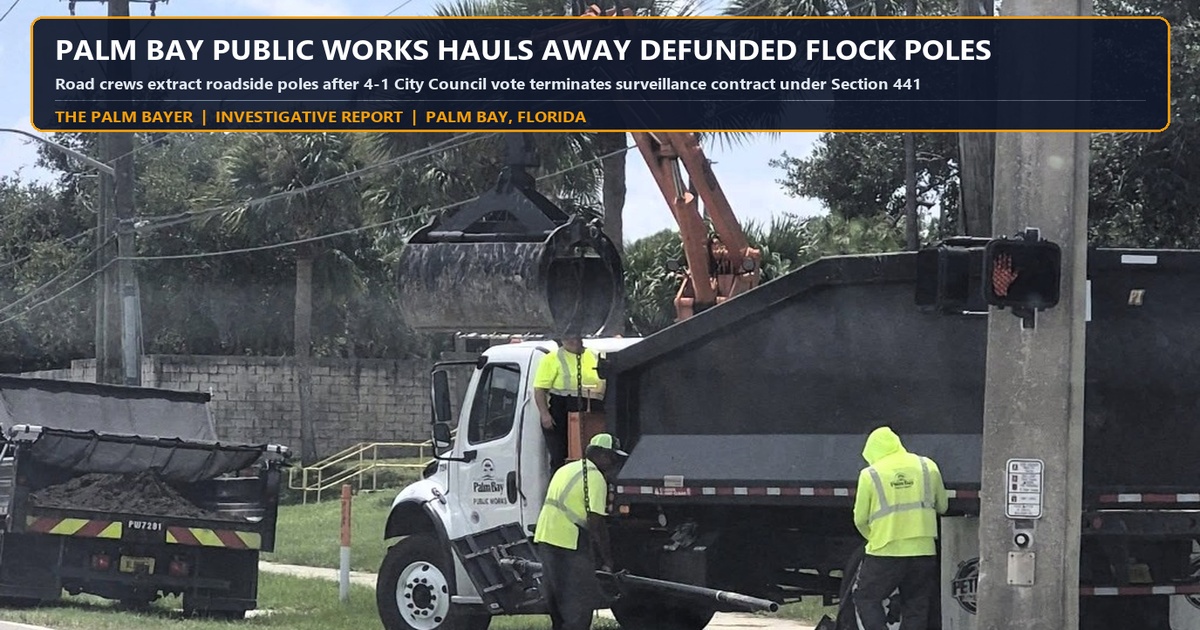
Reallocating Flock: The Aquatic Center Contingency Placeholder
The proposed budget officially de-funds the controversial Flock Safety automated license plate reader program, canceling line items 001-5013-521.54-02 ($3,500) and 001-5013-521.54-03 ($132,500) for a $136,000 reduction. In a direct dollar-for-dollar offset, staff shifted that exact $136,000 into General Fund Contingency (001-9010-519.56-01) designated as “Contingency Funding for Contractual Obligations associated with Palm Bay Aquatic Center.” Rather than restoring pool operations directly to the Recreation Department’s operating budget, the funds sit in contingency as a placeholder while City Council evaluates long-term operating options following community feedback over staff’s initial closure proposal.
The Rollback Rate: Why Lower Millage Yields More Revenue
On Wednesday night, City Council will vote to formally set the tentative operating millage rate at 6.6015 mills, a reduction of 0.0985 mills from the FY 2026 rate of 6.7000 mills.
The decision to propose the rolled-back rate took shape during the July 7 budget workshop. Under Florida Senate Bill 4-F, codified in Florida Statutes Chapter 200, any municipal millage rate exceeding the rolled-back rate requires a supermajority vote. With Councilman Chandler Langevin absent from that July workshop, Councilmen Kenny Johnson and Mike Hammer advocated strongly for fiscal restraint, making the four-fifths supermajority required to approve a rate above rollback legally unattainable. Staff subsequently built the budget baseline around 6.6015 mills, which requires only a simple majority vote.
Adopting the rolled-back rate does not mean overall property tax collections decrease.
Due to the addition of new construction and countywide property value appreciation, Palm Bay’s gross taxable valuation grew from $10.37 billion to $11.10 billion, an expansion of more than $730 million. As a result, ad valorem property tax revenues in the General Fund will increase by $3,628,624, rising from $66,851,010 to $70,479,634. Across all municipal funds, the city will collect $80,569,094 in property taxes.
In addition to the operating millage, property owners will pay a voted debt service millage of 0.9385 mills to fund annual principal and interest on the city’s voter-approved General Obligation road paving bonds. That rate is down slightly from 0.9993 mills last year and will generate $10,012,336 dedicated exclusively to road debt service. Combined, Palm Bay’s total proposed property tax rate for FY 2027 stands at 7.5400 mills.
Enterprise Funds: Water Rates Rise 8% to Fund $110M Reverse Osmosis Overhaul
While property tax millage is holding at the rolled-back rate, utility customers will see rate adjustments on their monthly statements beginning October 1. Included on Wednesday’s agenda are first readings for Ordinances 2026-34, 2026-35, 2026-36, and 2026-37, amending the municipal code to implement updated utility rates.
Under the rate schedule prepared by financial consultant Stantec Consulting Services Inc., utility charges will adjust across user categories: * Potable Water Rates: Increasing by 8.0%. * Wastewater (Sewer) Rates: Increasing by 3.75%. * Reclaimed Water Rates: Increasing by 3.75%.
For an average single-family residential customer using 5,000 gallons of water per month, a water-only monthly bill increases from $37.44 to $40.46 (an increase of $3.02 per month). For customers receiving both water and wastewater service, the combined monthly bill adjusts from $101.77 to $107.22 (an increase of $5.45 per month, or $65.40 annually).
The 8.0% water adjustment represents an acceleration from the city’s historical 1.75% annual water increase. This change is driven primarily by the need to finance major capital investments, led by the $110 million to $115 million North Regional Reverse Osmosis Water Treatment Plant. That multi-year facility overhaul is required to comply with new federal Environmental Protection Agency (EPA) drinking water standards governing per- and polyfluoroalkyl substances (PFAS), which set a maximum contaminant level of 4.0 parts per trillion.
Despite the acceleration, regional utility rate comparisons in Stantec’s report demonstrate that Palm Bay’s monthly charges remain competitive with neighboring municipalities. For a standard 5,000-gallon residential customer: * Water-Only ($40.46): Lower than Brevard County ($41.37), Melbourne ($41.98), West Melbourne ($58.75), and Port St. Lucie ($61.75). * Combined Water & Sewer ($107.22): Lower than Brevard County ($108.81), Holly Hill ($113.76), Edgewater ($131.02), and Port St. Lucie ($132.52), and comparable to Melbourne ($102.67) and Daytona Beach ($104.76).
Palm Bay’s utility system is undertaking substantial capital work to guarantee clean, compliant drinking water for future decades, but the resulting monthly bills remain in line with regional benchmarks.
Understanding the Reserve Draw: What the 2024 CAFR Tells Us
The proposed General Fund budget presents an operating shortfall of $4,451,137, with proposed expenditures of $135,821,973 against recurring revenues of $131,370,836. To balance the ledger on paper, the administration has budgeted a $4,451,137 draw from unassigned fund balance reserves.
This budgeted reserve draw can understandably cause concern, but the audited 2024 Annual Comprehensive Financial Report (CAFR) demonstrates that this is standard municipal budgeting practice rather than a sign of fiscal instability.
In FY 2024, the city faced similar revenue constraints, discussed spending limitations under the 3% cap, and budgeted paper reserve draws. Yet when the fiscal year ended and external auditors completed the CAFR, the city did not experience a deficit. Instead, it closed the books with millions of dollars in net operational surpluses and fund balance rollovers.
Historically, that year-end buffer is generated by structural factors built into municipal budgeting: * Budgeted Vacancies: Authorized positions that remain vacant during the year generate substantial payroll and benefit savings, producing more than $6.8 million in unspent personnel funding across city funds in FY 2024. * Conservative Revenue Forecasting: Intergovernmental revenue sharing, franchise fees, and interest earnings consistently outpace staff’s conservative budget projections. * Departmental Savings: City departments routinely operate under their allocated spending caps, returning unspent funds at the end of each quarter.
Those unspent surpluses rolled over into city reserves, building the very cushion the administration is drawing upon today. Budgeted reserve draws during the September hearings reflect cautious planning, not an immediate drain on city stability. Palm Bay’s overall reserve levels remain healthy.
The Council Vote: What Happens Wednesday Night
Wednesday’s meeting is the first of two statutory public hearings mandated by Florida law before the final budget takes effect on October 1. The proceedings will follow a clear procedural order: 1. Tentative Millage Adoption: Council will open a public hearing to discuss the tentative operating millage rate of 6.6015 mills and voted debt service rate of 0.9385 mills, followed by a formal vote setting the tentative millage ceiling. 2. Utility Ordinances First Reading: Council will hold first readings and votes on Ordinances 2026-34 through 2026-37, advancing the water and wastewater rate adjustments. 3. Budget Ordinance First Reading: Council will vote on the first reading of Ordinance 2026-38, adopting the tentative FY 2026-2027 Annual Operating Budget of $457,286,978.
The second and final public hearing for budget adoption is scheduled for Wednesday, September 23, 2026.
How to Make Your Voice Heard
Local government budgets reflect the priorities of the community, and public input is an essential part of the hearing process.
Residents who wish to address City Council on the proposed budget, property tax rates, recreation funding, or utility rates may attend in person: * Location: City Hall Council Chambers, 120 Malabar Road SE, Palm Bay, FL 32907 * Date & Time: Wednesday, September 9, 2026, at 6:00 PM * Public Comment: Public comments on public hearing items are heard before Council votes. Speakers typically receive three minutes at the podium.
Residents who cannot attend the meeting in person can submit written comments directly to the Mayor and all four Council members by emailing the unified council inbox at citycouncil@palmbayfl.gov. Written comments submitted ahead of the meeting become part of the public record and provide direct guidance to the dais before votes are cast.
Understanding the numbers behind the budget is the first step in effective civic participation. Wednesday night provides every Palm Bay resident the opportunity to take part in that process.