PALM BAY, FL (The Palm Bayer) — When municipal leaders exhaust their credit, run out of gas-tax revenue, and realize decades of unchecked residential growth have outpaced their asphalt, they stop defending the public purse. They look for an authority to take over the burden.
On Tuesday morning in Viera, the City of Palm Bay officially raised the white flag.
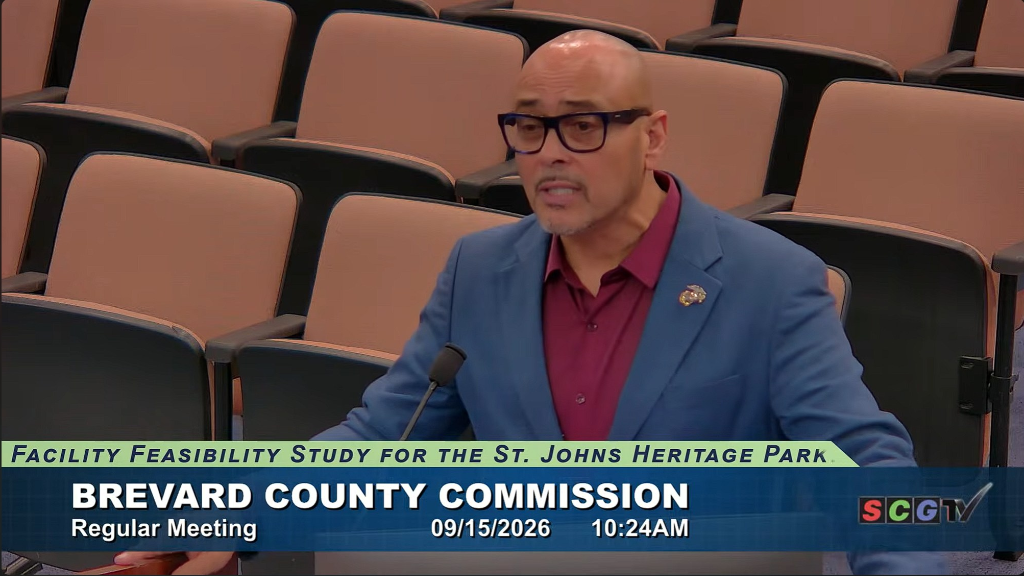
Appearing before the Brevard County Board of County Commissioners on September 15, 2026, Palm Bay Mayor Rob Medina and Deputy City Manager Jason DeLorenzo made a joint pitch to surrender the city’s primary north-south transportation corridor to an outside toll agency. Medina told county commissioners that after years of searching for municipal, state, and federal dollars to bridge the unbuilt southern stretch of the St. Johns Heritage Parkway, bringing in the Central Florida Expressway Authority (CFX) to build and operate it as a toll road “may be our only hope.”
The County Commission did not hesitate. Voting 4-0, commissioners endorsed a formal letter requesting that CFX conduct a $1,000,000 feasibility study, paid for entirely by the Orlando-based expressway authority. Commission Chair Thad Altman went a step further, expanding the study’s scope from the unbuilt southern stretch to the entire 20-mile corridor stretching from Interstate 95 Exit 166 at Micco Road all the way north to Exit 182 at Ellis Road in Melbourne.
If the study converts into steel and asphalt, South Brevard will get its first toll highway. Local commuters who have paid property taxes and impact fees for decades will face daily user fees just to escape their own subdivisions.
Behind the unanimous votes and official handshakes sits a financial and planning reality that neither Palm Bay City Hall nor the Brevard County Commission explained to the public sitting in the gallery.
The $400 Million Funding Wall
The engineering problem confronting Palm Bay is straightforward: the city built two disconnected stubs of a regional highway and has no money to connect them.
The northern segment of the St. Johns Heritage Parkway currently runs from Malabar Road north into West Melbourne, connecting to US-192 and I-95 at Ellis Road. The southern segment consists of a lonely 1.67-mile east-west stub running from Babcock Street to the diverging-diamond interchange at I-95 Exit 166, which opened in August 2020.
Between those two segments lies an unpaved 13.5-mile gap.
That gap cuts straight through the Compound, a 2,784-acre municipal wasteland of platted, unpopulated dirt roads left behind by General Development Corporation’s 1990 bankruptcy. City officials have spent the past eighteen months attempting to clean up the area’s reputation, formally rebranding the northern sector as the “Phoenix Business Park.”
Rebranding does not lay asphalt.
“When I arrived in Palm Bay about a year and a quarter ago, we started having regular meetings about what we formerly called the Compound, now you heard the mayor say the Phoenix Business Park area,” Deputy City Manager Jason DeLorenzo testified before commissioners. “We’ve brought in almost $6.5 million of state and federal grants for infrastructure, but the one thing we kept bumping up against is how are we going to solve this 13.5-mile gap from Malabar Road down to the southern interchange. Our estimate is that’s going to be between $250 and $400 million to create that with land acquisition and everything else that’s going to be needed.”
The city’s economic development plans depend on bridging that gap. On September 1, 2026, Governor Ron DeSantis awarded Palm Bay a $3.5 million Florida Job Growth Grant to install 16,000 linear feet of 12-inch sanitary sewer force main. That utility line targets roughly 62.5 acres near J.A. Bombardier Boulevard, meant to unlock an estimated 1 million square feet of aerospace and defense manufacturing facilities.
Industrial freight cannot move on dirt paths. Manufacturing tenants cannot operate without multi-lane arterial access connecting directly to I-95. Faced with a $400 million construction bill and zero bonding capacity to fund it, Palm Bay turned to the toll authority.
Chair Altman seized on the moment, insisting the CFX study look well beyond the Compound.
“I work at the space center and it’s very difficult now,” Altman told the board. “We have a lot of employees who live in Palm Bay that work at the American Space Launch Center, but many of them are unable to work up there now because it’s about an hour and a half to two-hour drive. And they said the hard part is about 45 minutes to an hour of that is just getting out of Palm Bay.”
Altman’s solution: hand the entire 20-mile beltway over to CFX to evaluate tolling the whole line.
The $1.8 Million Local Double-Dip
While Palm Bay leaders were in Viera petitioning an expressway authority to take over the corridor, their own municipal public works department was doing the exact opposite.
The city is actively spending millions in taxpayer and developer dollars designing a traditional, free municipal road on the exact segment CFX is being asked to toll.
On August 6, 2026, the Palm Bay City Council unanimously approved Supplemental Agreement No. 1 with GFT, the engineering firm formerly known as Scalar Consulting Group, under Project 24PW03. That vote authorized $430,330.38 to push engineering drawings to 90 percent completion for widening the Parkway from two lanes to four lanes between Malabar Road and Emerson Drive. The total engineering phase for that widening carries a $3.3 million budget, combining a $1.5 million state legislative grant with over $1.7 million in local developer-paid Transportation Impact Fees split between accounts Nexus 32907 and Nexus 32908.
Just one month earlier, on July 2, 2026, Council approved Consent Agenda Item 15, handing Scalar Consulting Group another $689,596 under Project 26PW03. That contract funds the civil engineering and geometric design for a permanent modern roundabout at the intersection of Malabar Road and the Parkway, backed by a $700,000 developer impact fee allocation.
Between the two contract awards approved this summer alone (the $430,330.38 widening supplement and the $689,596 roundabout contract), Council committed $1,119,926.38 ($1.12 million). Combined with prior preliminary engineering agreements, Palm Bay has dedicated over $1.8 million in local developer-paid Transportation Impact Fees and state grants toward designing a free municipal road, as part of the broader $3.3 million engineering phase budget.
These municipal projects are designing a low-speed, suburban surface arterial. The blueprints call for at-grade intersections, raised medians, commercial curb cuts, pedestrian sidewalks, bicycle paths, and traffic signals at Pace Drive and Emerson Drive.
An expressway authority operates under completely different engineering standards.
CFX does not build suburban streets with roundabouts and crosswalks. It builds 60-plus mph, limited-access toll highways. Its engineering manuals require grade-separated flyovers, closed access rights, wide clear zones, and diamond or partial-cloverleaf interchanges spaced miles apart.
Converting a newly engineered surface arterial into a limited-access toll road creates severe legal and financial risks:
- Sunk Design Waste: The $689,596 roundabout design at Malabar Road faces complete obsolescence the moment CFX requires a high-speed grade-separated interchange.
- The Taxpayer Double-Dip: Between the $1.12 million approved this summer and prior design allocations, over $1.8 million in local impact fees and state funds has already been dedicated to engineering a free municipal road. If CFX takes over the corridor, those same residents will pay toll gantries every morning to drive on pavement they already paid to engineer.
- Access Severance and Litigation Risk: Florida law protects private access rights. Converting an open municipal arterial into a limited-access tollway means sealing off commercial driveways, closing median cuts, and eliminating neighborhood left turns. Under the Bert J. Harris Jr. Private Property Rights Protection Act and Florida inverse condemnation statutes, severing direct road access creates substantial legal exposure and litigation risk from commercial parcels, churches, and subdivisions along the Malabar-to-Emerson stretch.
Palm Bay is spending tax dollars to design a road for local neighborhood traffic while simultaneously petitioning an Orlando toll agency to wall it off.
The Feasibility Deficit: Exposing the Math
Toll roads are not built on good intentions. They are built on bond covenants.
To sell municipal revenue bonds on Wall Street, CFX must hire traffic consultants to produce a certified Traffic and Revenue (T&R) study proving that toll collections will pay the annual principal and interest on the construction debt, plus a mandatory safety cushion.
When you run the hard numbers on the St. Johns Heritage Parkway, the financial math collapses.
According to baseline traffic telemetry from the Florida Department of Transportation’s Florida Traffic Online system, the existing 6.09-mile built segment of the Parkway between Malabar Road and US-192 (FDOT Roadway ID 70000399) carries an Annual Average Daily Traffic (AADT) volume of just 8,700 vehicles.
That 8,700 figure is not even a hard count. FDOT data flags it with administrative codes S, F, and C, meaning it is a factored computer estimate. There is not a single permanent or portable count station on the pavement.
Meanwhile, two miles to the east, Babcock Street (State Road 507) carries 38,000 vehicles a day. Free of charge.
The engineering math on toll revenue is unforgiving:
- 8,700 vehicles per day multiplied by 365 days yields roughly 3.18 million annual vehicle trips on the Parkway.
- When an open road becomes a toll road, a large percentage of drivers divert to free routes. Even if you assume an aggressive 60 percent retention rate (meaning four out of ten drivers choose free Babcock Street or Minton Road instead), only 1.9 million trips remain.
- At a standard toll rate of $1.25 per vehicle, existing traffic produces approximately $2.38 million in gross annual toll revenue.
Now look at the debt service required to build the unpaved 13.5-mile gap through the Compound.
Standard 30-year toll revenue bonds carry coupon rates between 5.0 and 5.5 percent. Under CFX bond covenants, the agency must maintain a minimum Net Debt Service Coverage Ratio (DSCR) of 1.25x, meaning net toll revenues after operating and maintenance costs must equal 125 percent of the annual bond payment. CFX internal board policy sets an even stricter planning target of 1.45x to 1.60x.
| Capital Construction Cost | Bond Coupon Rate | Annual Debt Service | Required Net Revenue (1.25x Covenant) | Existing Traffic Toll Revenue | Annual Revenue Deficit | Multiple of Current Traffic Required |
|---|---|---|---|---|---|---|
| $250 Million | 5.0% | $16.26 Million | $20.33 Million | $2.38 Million | $17.95 Million / year | 8.5x |
| $250 Million | 5.5% | $17.20 Million | $21.50 Million | $2.38 Million | $19.12 Million / year | 9.0x |
| $400 Million | 5.0% | $26.02 Million | $32.53 Million | $2.38 Million | $30.15 Million / year | 13.7x |
| $400 Million | 5.5% | $27.52 Million | $34.40 Million | $2.38 Million | $32.02 Million / year | 14.5x |
Existing traffic covers barely 7 to 12 percent of the required bond debt.
To make this project appear financially viable on paper, CFX’s feasibility study must manufacture between $18 million and $32 million in new revenue every single year.
To bridge that annual gap, traffic on the Parkway cannot stay at 8,700 vehicles a day. Even when embedding the aggressive 60 percent retention assumption, the corridor would need to generate between 74,000 and 126,000 vehicles per day to cover the debt. For perspective, the lower bound rivals existing I-95 traffic volumes through Central Brevard, while the upper bound substantially exceeds it.
South of Malabar Road, FDOT maintains zero traffic counts because the road does not exist. There is zero baseline traffic in the Compound. Every single dollar of projected revenue in that southern half must be invented out of whole cloth by CFX consultants using aggressive compounding population projections through the year 2045.
CFX maintains an internal financial guideline requiring that projected toll collections cover at least 50 percent of a project’s total capital cost before the agency moves forward. Under real-world numbers, a standalone St. Johns Heritage Parkway cannot meet that threshold.
However, CFX has established a precedent for ignoring its own rules.
In 2018, CFX mothballed the proposed Southport Connector in Osceola County because projected tolls covered only 17 to 29 percent of its construction costs. On December 11, 2025, the CFX board reversed itself, voting unanimously to approve the Project Development and Environment (PD&E) study preferred alternative for the 15-mile, $2.54 billion expressway anyway. The board advanced the project even though projected toll collections covered only 29 percent of capital costs, directing staff to seek external funding partnerships while relying on system credit to bridge the remaining gap.
Residents in Poinciana dubbed that project “The Great Wall of Poinciana” after realizing CFX planned to run an elevated toll viaduct down the median of Cypress Parkway, walling off their local businesses and neighborhoods.
CFX does not issue standalone project debt. Under its Master Bond Resolution, all bonds are secured by system net revenues, pooled from toll gantries across SR 408, SR 417, and SR 528 in Orange and Seminole counties. Wall Street views that system credit favorably. On July 24, 2026, Fitch Ratings upgraded CFX’s senior lien revenue bonds to ‘AA-‘, explicitly citing the agency’s “demonstrated willingness and ability to implement toll increases even during challenging economic times.”
If political pressure is high enough, CFX can waive its 50 percent guideline, lean on its upgraded AA-minus credit rating, and let Orlando toll-payers subsidize South Brevard asphalt until local toll gantries can squeeze enough cash out of Palm Bay drivers.
Unlocking 7,000 Developer Acres
If the existing traffic cannot pay for the road, who benefits from building a $400 million limited-access highway through the southern brush?
The answer sits inside the county property appraiser’s parcel records.
Because an expressway authority prohibits local driveways and private curb cuts, access along the 13.5-mile southern extension will be restricted to three or four grade-separated interchanges. In real estate development, controlling the land surrounding an expressway interchange is the equivalent of striking oil.
The southern corridor runs directly through nearly 7,000 contiguous acres held by two massive private land entities:
1. Rolling Meadow Ranch, Inc. (Andrew Machata)
Headquartered in Vero Beach, Rolling Meadow Ranch owns nine contiguous parcels totaling 1,346.66 acres directly straddling the path of the southern extension west of Babcock Street. The property includes major tracts at 1200 and 1400 Willowbrook Street, currently carrying agricultural tax classifications with a combined 2025 market valuation of $5.28 million.
The Machata family has spent years preparing this land for development. The master plan for Rolling Meadow Lakes calls for over 2,000 single-family residential homes. In late 2025, the developer filed St. Johns River Water Management District Permit #248179 to construct the first 1.0-mile physical segment of the Parkway through its own property.
The Machata property holds a unique legislative history. Annexed into the City of Palm Bay in 2005, the developer successfully bypassed the city in 2019 by lobbying the Florida Legislature. Lawmakers passed Chapter 2019-173, Laws of Florida (House Bill 1063, sponsored by former Representative Randy Fine), which forcefully deannexed the 1,346 acres from Palm Bay and returned them to unincorporated Brevard County.
The special act contained a crucial statutory catch: it legally compelled the City of Palm Bay to provide municipal water and sewer utility capacity to Rolling Meadow Lakes at standard city rates, while explicitly prohibiting Palm Bay from requiring annexation as a condition of service.
Rolling Meadow Ranch stripped Palm Bay of its property tax base, forced the city to supply its utilities, and now stands to have an expressway authority build a multi-hundred-million-dollar highway right to its front door.
2. Jaric Holdings LLC (The Canadian Syndicate)
Immediately west and northwest of the Machata ranch lies an even larger real estate empire.
Registered to a corporate address in Gravenhurst, Ontario, Canada, Jaric Holdings LLC controls twelve contiguous parcels totaling roughly 5,628 acres. This tract, the former Sartori family ranch lands along Willowbrook Street, was acquired in December 2023 for the planned SunTerra Lakes development, a master-planned community slated for 2,700 to 3,000 homes. The Brevard County Commission approved the comprehensive rezoning for that acreage in September 2024.
Together, Rolling Meadow Ranch and Jaric Holdings control 6,975 contiguous acres in the southern third of the gap. Every single acre sits within two miles of the proposed southern interchange nodes at Grant Road and I-95 Exit 166.
The financial arrangement is unmistakable.
Current Palm Bay working-class commuters paying daily tolls on the northern stretch between Malabar Road and Ellis Road will generate the system revenues used to service construction bonds. Those bonds will pave the highway that transforms 7,000 acres of raw agricultural cow pastures into billions of dollars in private suburban real estate value for an out-of-town developer and a Canadian land trust.
The public pays the tolls. The developers bank the land equity.
The Political Handoff: Brevard’s Infrastructure Paradox
The true irony of the September 15 County Commission vote was not found in what commissioners said about the Parkway. It was found in what they refused to do fifteen minutes earlier.
Immediately prior to Mayor Medina’s presentation, the Board of County Commissioners debated Item J.3: consideration of a countywide 9th-cent fuel tax.
Public Works staff presented the board with an unvarnished reality: Brevard County faces hundreds of millions of dollars in backlogged road resurfacing, bridge maintenance, and drainage failures. A local 1-cent-per-gallon fuel tax would generate approximately $9.1 million annually, dedicated strictly by Florida law to local road repaving and transportation safety.
Faced with a vote that required political spine, the commissioners backed down.
Rather than enacting the gas tax, commissioners debated whether electric vehicles were dodging the pump, worried about public blowback, and ultimately punted the decision to a potential voter referendum in November 2028. Commissioner Rita Pritchett, appointed by Governor DeSantis in July 2026 to backfill former Commissioner Katie Delaney’s county commission vacancy, openly acknowledged the political fear on the dais: “You’re going to get near elections times again that time and everybody gets a little more hesitant. It’s going to depend on whether you’re willing to take that hit, which I hope you are because that’s what makes public leadership fun: going ahead and just doing what you know is right.”
Minutes earlier, during Item J.2, commissioners voted to siphon $889,949 from Tourist Development Council capital reserves, moving the funds into marketing so they could cover county ocean lifeguards and plug an $889,000 hole in the county’s General Fund.
The contrast was absolute.
When it came to maintaining the local county roads residents drive on every day, the commission refused to levy a single penny at the pump and raided tourism reserves to keep the General Fund afloat. But when the City of Palm Bay walked in and offered to bring in a regional toll authority that will charge commuters $2.50 or more every round-trip to drive through South Brevard, the board approved it without a single dissenting vote.
Commissioners did not want the political blame for a 1-cent gas tax. They were happy to outsource a multi-dollar toll gantry to an appointed regional toll authority.
The abdication became complete during the final minutes of the meeting.
During public comment on Item J.4, District 1 resident Rick Hefinger walked to the podium and dropped an uncomfortable administrative fact onto the record: Brevard County has had zero voting representation on the Central Florida Expressway Authority board since April 2026, following the sudden resignation of former Commissioner Katie Delaney.
For five months, Brevard had no voice in Orlando.
At timestamp 02:04:17, during the board’s closing reports, Chair Altman addressed the vacuum.
“It came up earlier we have a vacancy on the Central Florida Expressway Authority Board,” Altman announced from the center chair. “I would very much like to serve on that since I’m going to be in the midst of this issue.”
Commissioner Feltner made the motion. Commissioner Pritchett seconded. The vote was unanimous.
Without any public application process, debate, or citizen notice, Altman nominated himself for the board’s vote to fill Brevard County’s sole governing seat on CFX.
While Florida statute establishes that Brevard’s seat on the CFX governing board is designated for a county commissioner, the dual role creates an undeniable structural tension. Altman now sits on both sides of the negotiating table: serving as Chair of the Brevard County Commission petitioning for the road, and sitting as a voting member of the CFX governing board evaluating the petition.
The Regional Extraction Funnel: Who Actually Wins?
The engineering conflict and bond debt expose a deeper regional game. This project is not being built to serve Palm Bay. It is being built as a regional bypass around Palm Bay, using local commuter tolls to subsidize outside economic interests.
For more than a decade, regional long-range transportation plans framed the St. Johns Heritage Parkway as a true western beltway. The original planning vision carried the corridor north beyond Ellis Road and US-192, pushing directly into Stadium Parkway and Lake Andrew Drive in Viera. That northern connection would have provided South Brevard commuters with an independent, signal-free route straight to the Brevard County Government Center, Viera Hospital, and central county commerce without ever merging onto Interstate 95.
In the CFX feasibility study endorsed by commissioners, that Viera connection does not exist.
Instead, the northern study boundary truncates abruptly at Exit 182 (Ellis Road) in Melbourne. By dumping all northbound traffic onto Ellis Road, the tollway acts as an employment conveyor belt feeding Melbourne’s corporate aerospace and defense cluster. Companies like Northrop Grumman, L3Harris, and Embraer capture the high-wage workforce, while the City of Melbourne captures the industrial tax base. Palm Bay remains the residential bedroom community, bearing the public service costs while its residents pay daily tolls to reach their jobs.
To the south, instead of connecting to Palm Bay’s established commercial core, the tollway plunges through the Compound to unlock nearly 7,000 private developer acres in unincorporated Brevard.
The regional balance sheet is completely one-sided: - Palm Bay taxpayers and local homebuilders already committed over $1.8 million in local impact fees and state grants to engineer a free municipal road. - Daily commuters will pay electronic CFX toll gantries every morning to drive on it. - Those toll revenues underwrite the bond debt required to pave the southern reach through the Compound. - The northern interchange feeds Melbourne’s tax base, while the southern interchange unlocks private developer fortunes in unincorporated Brevard.
Palm Bay gets no direct connection to Viera, no relief on I-95, and no commercial windfall. It simply serves as the captive tollbooth in the middle.
The Citizen’s Audit Checklist
The $1,000,000 feasibility study is now in motion. CFX will spend the next twelve to eighteen months running traffic simulations, environmental assessments, and revenue projections.
Palm Bay taxpayers and daily commuters cannot afford to sit on the sidelines while consultants draft the blueprints. When CFX and the Space Coast Transportation Planning Organization roll out the draft Traffic and Revenue study for public review, residents must ignore the slick public-relations renderings and examine three specific data pages:
- The Baseline Diversion Rate: Look at what percentage of current Malabar Road and Babcock Street drivers the consultants assume will willingly pay tolls. While preliminary promotional models float an aggressive 60 percent retention rate, any long-term baseline model assuming higher than 50 percent retention in a corridor flanked by parallel free routes artificially inflates revenue.
- The 2045 Growth Curves: Audit the population and traffic growth rates assigned to the unmeasured southern reach through the Compound. If the feasibility case relies on compounding 4 percent annual traffic growth in an empty swamp, it is speculative fiction designed to satisfy bond rating agencies.
- The Access-Management Concept Plan: Demand to see the interchange spacing maps for the Malabar-to-Emerson segment. Count every median opening, left-turn lane, and business driveway marked for closure. That map is the blueprint for local business disruption and taxpayer-funded Bert Harris property lawsuits.
The warning flags are flying. Palm Bay leadership has openly confessed they cannot fund the roads their growth requires. Brevard County commissioners have proven they would rather surrender local highways to toll authorities than make hard budget decisions in Viera.
The price of that surrender will not be paid by the politicians who voted for the study or the developers sitting on 7,000 acres in the southern scrub.
It will be deducted electronically from your SunPass account every time you drive to work.