PALM BAY, FL (The Palm Bayer) — When the Palm Bay City Council gavels in for its regular meeting on Thursday, October 1, 2026, the official agenda will show 32 numbered items spanning hundreds of pages of municipal business. But the sharpest financial moves of the night are tucked away where few casual observers ever look: on the consent agenda.
- What Happened: City administration has scheduled $1,557,943 in utility capital spending across the consent agenda for a single en bloc vote, including a $603,614 retroactive payout for an emergency sewer replacement and $954,329 for Phase 1 of a water utility SCADA overhaul shielded under state cybersecurity secrecy exemptions.
- Why Residents Care: The emergency sewer repair bypassed standard city procurement by piggybacking on an existing City of Titusville contract seven weeks after the hole opened along the railroad corridor. Simultaneously, unaudited third-quarter financial records reveal that Palm Bay's General Fund operating cash dropped $4.87 million (-7.8%) year-over-year while operating expenditures jumped 9.0%.
- What's Next: Council convenes Thursday, October 1, 2026, at 6:00 PM at City Hall. Any council member can pull either utility spending item for public debate. Council will also conduct final hearings on land development rules forcing homebuilders to post demolition bonds for abandoned subdivisions.
The $1.55 Million Consent Squeeze
Consent agendas are designed for ministerial housekeeping. In municipal procedure, consent calendars exist to clear non-controversial business in a single, un-debated vote: routine approval of past meeting minutes, advisory board appointments, standard grant acceptances, and ceremonial proclamations.
When an administration groups seven-figure capital outlays into that identical bucket, legislative procedure turns into a financial rubber stamp.
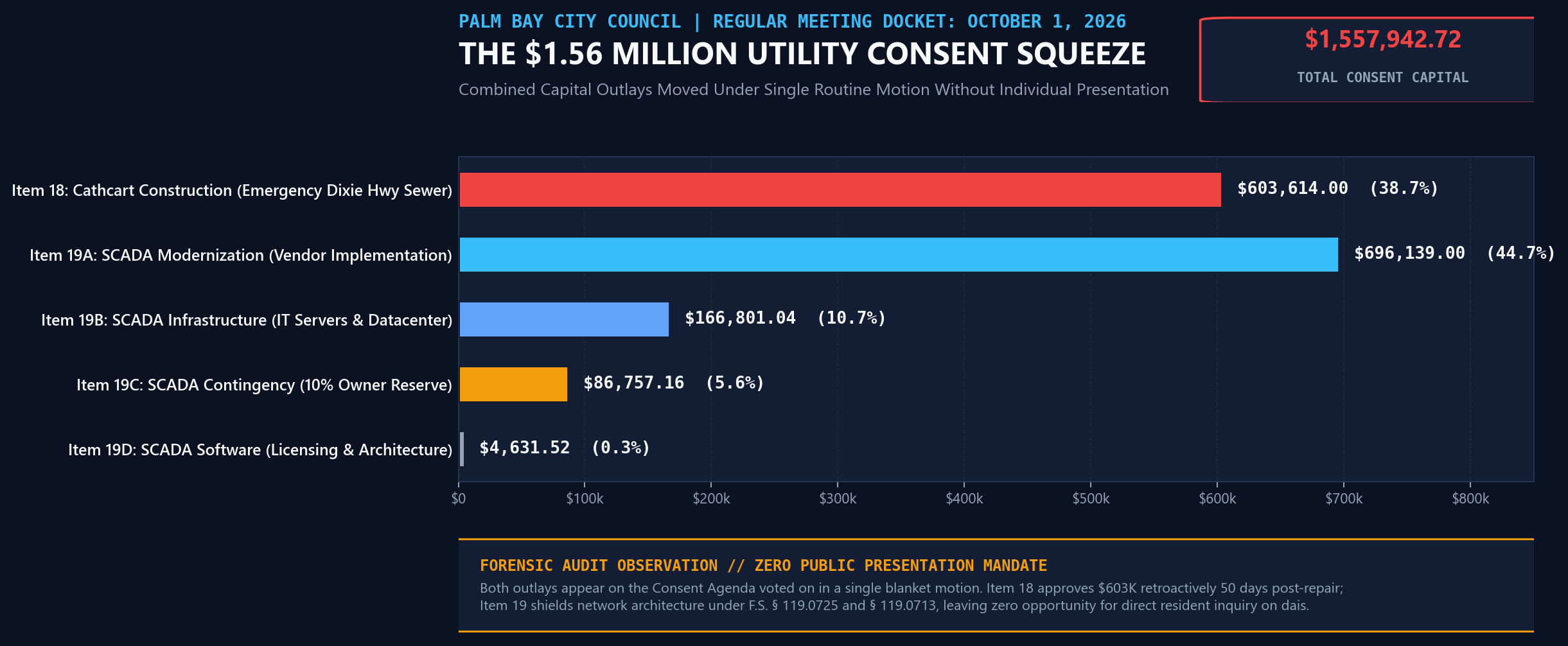
On October 1, City Council is slated to approve $1,557,942.72 in municipal utility capital commitments through a single collective motion. The package couples a $603,614.00 retroactive reimbursement for an emergency sewer main excavation with a $954,328.72 authorization for industrial automation and supervisory control upgrades.
As detailed in Figure 1, the utility consent docket divides into two major authorizations: * SCADA Modernization Phase 1 (Item 19): $954,328.72 (61.3% of the consent utility total), consisting of $696,139.00 for vendor implementation, $166,801.04 for IT server infrastructure, $86,757.16 for a ten percent contingency reserve, and $4,631.52 for software licensing. * Cathcart Emergency Sewer Repair (Item 18): $603,614.00 (38.7% of the consent utility total), paying for an emergency gravity sewer rebuild under a piggybacked intergovernmental contract.
Neither item is scheduled for an administrative presentation. Neither item requires a vendor appearance before the dais. Unless an individual council member exercises the procedural authority to remove an item from consent, the entire $1.56 million sum will pass without a single public question asked from the dais.
This maneuver effectively shifts scrutiny from the public record to internal administrative discretion. Ratepayers watching the broadcast will see formal recognitions for municipal employees and proclamations for civic awareness months, followed immediately by an en bloc vote that commits more than one and a half million dollars of water and sewer capital in the span of five seconds.
The $603,614 Titusville Piggyback Sewer Job
The costliest single item on the consent docket sits under Item 18: a retroactive $603,614 check to Cathcart Construction Company - Florida, LLC for an emergency gravity sewer repair at 3630 Dixie Highway.
The emergency began on Wednesday, August 12, 2026, when field crews reported a surface depression near an existing manhole along the U.S. 1 corridor. Inspection revealed a compromised, 14.5-foot deep concrete structure on the verge of total collapse. The manhole serves as a critical wastewater collection artery, receiving raw sewage from multiple upstream lift stations and handling major flow volumes along the eastern spine of Palm Bay’s sewer network.
City engineers faced immediate operational risks. A structural collapse would trigger an uncontained sanitary sewer overflow into surrounding areas, triggering environmental harm along with state notification, reporting, and corrective action requirements. Furthermore, the excavation site sat directly adjacent to the railroad right-of-way, creating severe excavation and coordination challenges with freight rail operations while dewatering saturated soil.
Faced with those conditions, the Utilities Department acted swiftly to stabilize the ground. Specialized well-point dewatering systems and continuous bypass pumps were mobilized to redirect sewage flows around the breach. Cathcart Construction excavated 14.5 feet into the water table, extracted the destroyed concrete structure, replaced the manhole, and repaired damaged connecting gravity lines.
The operational response resolved the physical hazard. The procurement process that followed reveals how City Hall sidesteps standard bidding.
Instead of issuing an emergency solicitation or relying on an existing municipal term contract, the administration piggybacked on City of Titusville Contract No. CN24P020/LR, an agreement established for utility contractors’ services in north Brevard County that remains valid through April 9, 2027. City Manager Matthew Morton and Interim Chief Procurement Officer David Gragan were formally notified of the emergency on August 13, 2026.
Yet City Council is only being asked to acknowledge the emergency procurement, waive formal bidding, and approve the $603,614 invoice on October 1: exactly fifty days after the breach occurred and seven weeks after the emergency notice was signed.
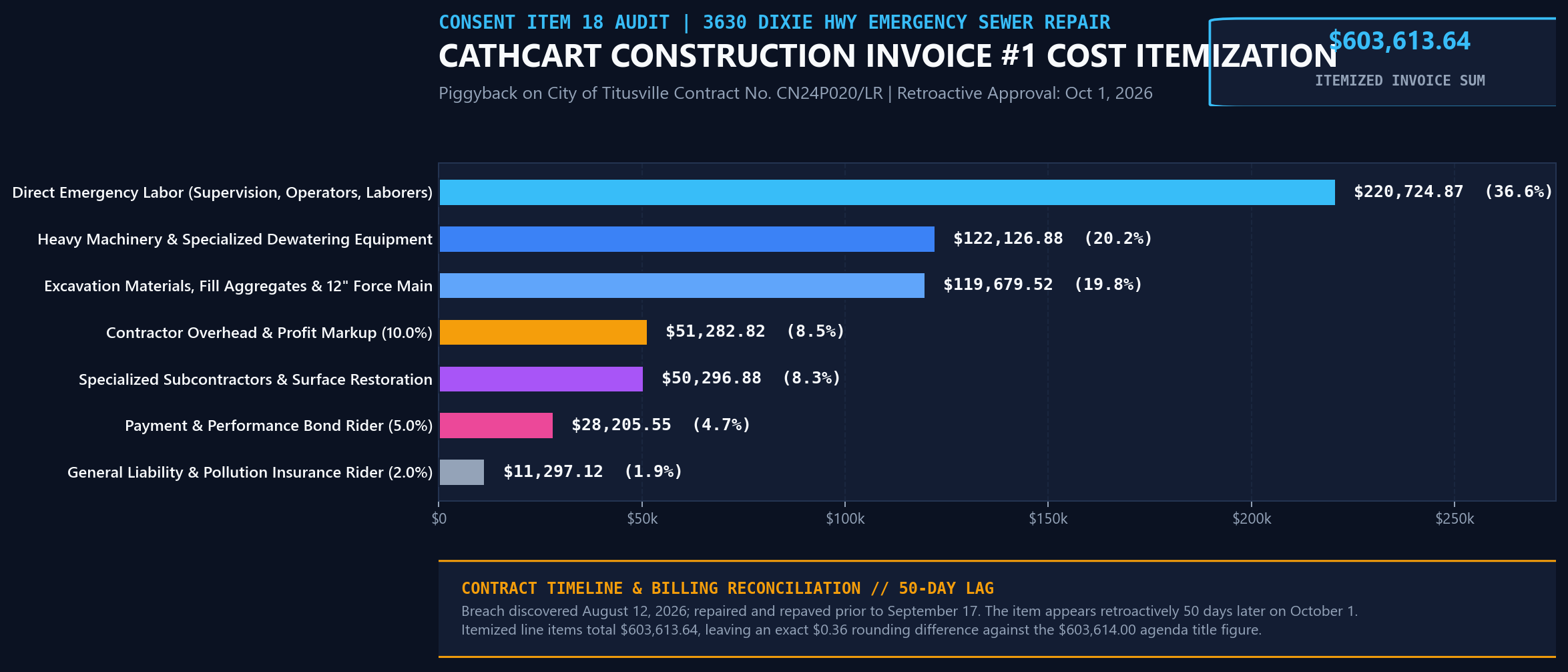
As audited in Figure 2, the exact line-item costs on Cathcart Invoice #1 break down as follows: * Direct Labor: $220,724.87 (36.6% of direct costs, covering standard and overtime hours for operators, foremen, and skilled laborers) * Heavy Equipment: $122,126.88 (20.2%, deploying size 85, 325, and 350 excavators, front-end loaders, skid steers, and water trucks) * Direct Materials: $119,679.52 (19.8%, including precast manhole sections, pipe, and aggregate backfill) * Subcontractors & Services: $50,296.88 (8.3%, covering specialized bypass pumping and dewatering operations) * Contractor Overhead & Profit (10%): $51,282.82 (8.5%) * Payment & Performance Bond (5%): $28,205.55 (4.7%) * Liability Insurance (2%): $11,297.12 (1.9%) * Total Itemized Invoice Sum: $603,613.64
The line items sum to $603,613.64, leaving an exact thirty-six cent rounding difference against the $603,614.00 agenda title figure. The entire sum is funded from the Utilities Renewal and Replacement Fund.
Emergency field repairs are a reality of aging underground infrastructure. But presenting an invoice seven weeks after the fact on the consent agenda eliminates any meaningful council oversight. The pipe is already in the ground, the trench is backfilled, the pavement is restored, and the money is effectively spent. Council has no practical alternative other than to ratify the bill.
The $954,329 SCADA Modernization: Cybersecurity Exemptions and Fiscal Oversight
Right behind the sewer repair sits Item 19: an authorization request for $954,328.72 to launch Phase 1 of the Utilities Department Supervisory Control and Data Acquisition (SCADA) Modernization Program under Project 26WS14.
SCADA systems represent the operational core of municipal utilities. They link remote telemetry units, water treatment facilities, wastewater lift stations, and storage tanks into a centralized digital control network, enabling operators to monitor water pressure, regulate chemical treatments, monitor system flows, and coordinate industrial pumping in real time.
According to the memorandum submitted by Utilities Director Gabriel Bowden and City Manager Matthew Morton, the modernization initiative is designed to transition aging industrial control platforms to a modern environment, enhance system resiliency, and align utility operational technology with contemporary cybersecurity and regulatory standards. As systems age, obtaining replacement components and manufacturer support becomes increasingly challenging, making a phased modernization standard industry practice.
The financial breakdown for Phase 1 includes: * SCADA Implementation and Integration: $696,139.00 * Server Infrastructure (IT Department): $166,801.04 * Software Licensing: $4,631.52 * Phase 1 Base Subtotal: $867,571.56 * Discretionary Contingency (10%): $86,757.16 * Total Phase 1 Authorization: $954,328.72
Specific technical schematics, network configurations, software architectures, and hardware layouts are intentionally absent from the public agenda packet. Staff explicitly cited Florida Statutes § 119.0725(1) and (2) alongside § 119.0713(5)(a), which classify operational technology and utility cybersecurity data as confidential and exempt from public disclosure. Shielding network configurations, operational technology schematics, and hardware layouts under these statutes is an essential, lawful, and necessary public safety practice to safeguard critical municipal drinking water and wastewater infrastructure from modern cyber threats. Under Florida Statutes § 119.0725(3), any portion of a public meeting where technical infrastructure details might be revealed is likewise exempt from Florida open meetings law (the Sunshine Law, Florida Statutes § 286.011).
The watchdog issue facing the dais is not why technical schematics are shielded from public view, as protecting critical infrastructure is legally required and operationally prudent. The substantive question centers entirely on legislative procedure and fiduciary governance: why a major $954,328.72 capital authorization is slated for an en bloc consent vote without an executive presentation outlining general project milestones, vendor accountability, and expenditure controls.
Staff is requesting an $86,757.16 contingency allowance upfront, noting that unforeseen site conditions or market pricing shifts could arise during implementation. Furthermore, Phase 1 represents only the initial installment of Project 26WS14, which carries an overall budgeted allocation of $1.5 million. Even where technical operational discussions are legally closed under Florida Statutes § 119.0725(3), City Council retains the fundamental fiduciary duty to publicly oversee capital appropriations, track project delivery timelines, and ensure disciplined stewardship of ratepayer utility funds.
The Q3 Cash Squeeze: General Fund Reserves Under Pressure
While utility enterprise funds absorb major capital expenditures, the city’s core operating budget is quietly burning cash.
Buried under Item 23 is the formal acknowledgment of Palm Bay’s Third Quarter Financial Report for Fiscal Year 2026. The FY26 Q3 Financial Report covers financial performance through June 30, 2026, representing the first nine months (75%) of the fiscal cycle.
The headline summary presented by City Manager Morton and Acting Chief Financial Officer Ruth Chapman strikes an optimistic note, reporting that citywide cash and investments increased by $8.94 million, or 2.0%, rising from $441,747,568 to $450,684,271 compared to the prior year.
A closer look at the accounting ledger exposes the structural tension beneath that top-line number.
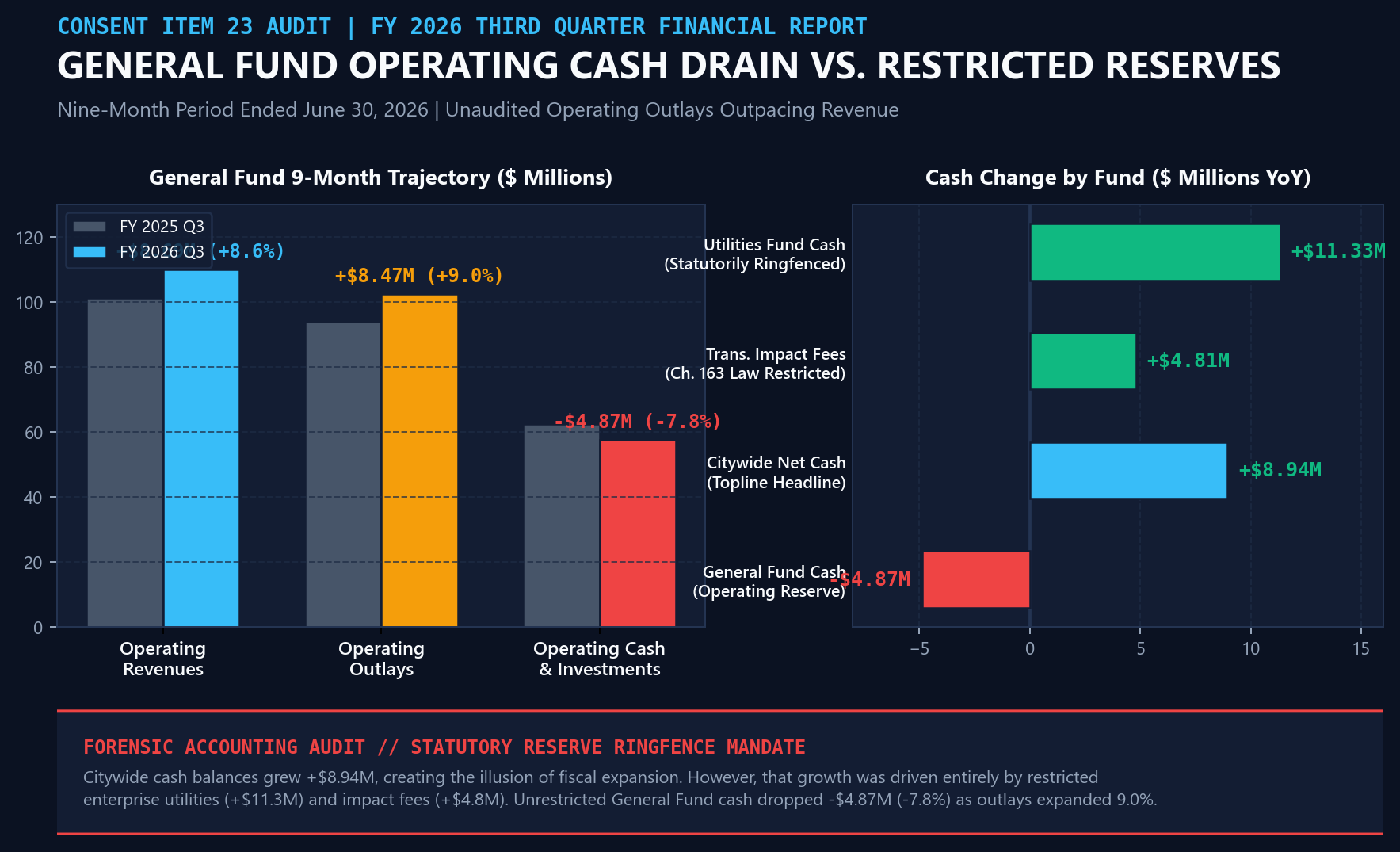
The administration explicitly notes that the citywide cash increase was primarily due to increased balances in restricted developer funds and utility accounts. Specifically, Utilities Fund cash grew by $11,327,117, while Transportation Impact Fees expanded by $4,813,118.
Those funds operate behind strict statutory firewalls. Under the Florida Impact Fee Act, Florida Statutes § 163.31801, impact fee collections are strictly prohibited from being used for general operating salaries, routine maintenance, police patrols, or administrative overhead; they can only fund new capital capacity demanded by population growth. Enterprise utility funds are legally dedicated to water and sewer operations, capital improvements, and revenue bond debt service.
Inside the General Fund, which finances Palm Bay’s daily public safety, road maintenance, and basic municipal operations, the cash trajectory reveals a persistent drain: * General Fund Cash and Investments: Dropped from $62,569,211 on June 30, 2025, to $57,700,569 on June 30, 2026. That represents an outright decline of $4,868,642, or a 7.8% reduction in operating liquidity. * General Fund Expenditures: Climbed from $94,008,203 to $102,481,200 through the third quarter, an escalation of 9.0% (+$8,472,997) over the same period last year. * General Fund Revenues: Totaled $109,926,988, up 8.6% (+$8,690,442) from $101,236,546 the previous year, driven almost entirely by higher ad valorem property tax receipts from countywide valuation gains.
As visualized in Figure 3, operating expenditures are expanding faster than revenues (+9.0% vs. +8.6%), even during a period of historic property tax intake. Operating cash has dropped nearly $4.9 million in twelve months. Using enterprise utility reserves and developer impact fee balances to present a positive citywide cash narrative obscures the fact that the city’s primary operating engine is absorbing a steady financial drain.
Development Code & Easement Overhauls: Demolition Bonds for Stalled Subdivisions
Beyond the financial maneuvers on consent, the legislative docket features substantive revisions to municipal land development rules during public hearings.
Ordinance 2026-30: Cumulative Compatibility Standards (First Reading)
Carried over from the September 17 meeting at staff request, Ordinance 2026-30 (Case T26-00005) amends Section 172.024 of the Land Development Code regarding conditional use permits.
Current city rules only require council to assess whether a proposed conditional use is compatible with immediate adjacent properties. The proposed amendment broadens that authority, allowing council to evaluate the location and distribution of existing conditional uses in the surrounding area and their cumulative effect on the character and function of the area.
The change gives the dais stronger legal footing to deny repetitive or high-intensity conditional uses (such as gas stations, self-storage facilities, or car washes) when multiple similar developments already cluster within a neighborhood corridor. The Planning and Zoning Board approved the measure 4-0.
Ordinance 2026-31: Demolition Bonds for Early-Start Subdivisions (Final Reading)
Under Ordinance 2026-31 (Case T26-00006), council will take a final vote on conforming city code to Florida Statutes Chapter 177 regarding expedited residential building permits.
Recent state legislation requires local municipalities to allow residential developers to pull building permits and begin construction on up to 50% of approved homes before subdivision improvements (roads, water mains, stormwater systems) are completed and before the final plat is formally recorded with the Brevard County Clerk of Court.
To prevent half-built subdivisions from becoming abandoned safety hazards during market downturns, Growth Management Director Althea Jefferson and city staff inserted aggressive municipal safeguards into Section 172.058: 1. Mandatory Demolition Bond: Section 172.058(B)(7) mandates that builders post a financial bond covering the full estimated cost to demolish all permitted structures should subdivision improvements stall and building permits expire. If development halts, the developer has exactly one year to raze the structures; failing that, the city will seize the bond proceeds and execute demolition itself. 2. Strict Occupancy Prohibition: Section 172.058(B)(9) explicitly states that neither a temporary nor a final Certificate of Occupancy will be issued under any circumstances until all subdivision infrastructure is certified complete and the final subdivision plat is officially recorded. 3. Fire and Utility Readiness: Structures must have verified 100% functional permanent power and sewer service, stabilized road access, and adequate water supply for emergency apparatus before vertical construction proceeds.
The Planning and Zoning Board recommended approval 4-0, specifically conditioning its endorsement on staff confirming that financial, fire safety, and no-occupancy restrictions remain legally enforceable against developers.
Ordinances 2026-40 & 2026-41: Easement Vacations
Rounding out the public hearing calendar are two private easement vacations, both of which passed first reading at Regular Council Meeting 2026-25 on September 17, 2026, without changes: * Ordinance 2026-40 (Case VE-4-2026): Applicants Larry Charles Blanford and Mark Lamont Johnson request the vacation of the Northerly 10 feet of the Southerly 20-foot Public Utilities and Drainage Easement, less the Easterly 6-foot easement and Westerly 25 feet, totaling 2,307.8 square feet across Lots 12 and 13, Block 1900, Port Malabar Unit 26. The vacation resolves an encroachment issue to bring an existing structure into municipal compliance. * Ordinance 2026-41 (Case VE-5-2026): Applicants Ramon and Maria Bustamante request the vacation of the Westerly 5 feet of the Easterly 10-foot easement, less the Northerly 6 feet, containing 420 square feet across Lot 8, Block 916, Port Malabar Unit 18. The vacation accommodates the construction of an inground backyard swimming pool.
Both requests have been vetted by Public Works and utility franchise providers to ensure no active municipal storm drainage or subsurface infrastructure is impaired.
Public Participation & Dais Logistics
Palm Bay City Council convenes for the Regular Council Meeting on Thursday, October 1, 2026, at 6:00 PM in the City Hall Council Chambers, located at 120 Malabar Road SE.
Council meetings are open to the public and broadcast live on the city website and local government access channels.
Residents wanting to speak on public hearing ordinances or request that consent items be pulled for discussion must submit a speaker card to the City Clerk before the relevant section is called. Written testimony and questions for the official record can be submitted prior to the meeting. For step-by-step instructions on registration deadlines and speaking rules, review our comprehensive guide on how to submit public comments for the official record.
Citizens can also communicate directly with the full council via email at citycouncil@palmbayfl.gov.
Whether council allows $1.55 million in ratepayer capital to slide through without a single question, or whether elected leaders force an on-the-record examination of emergency piggyback contracting and proprietary tech spending, will depend entirely on what happens the moment the consent agenda is called.