
PALM BAY, FL (The Palm Bayer) — The debate over automated roadside surveillance in Palm Bay officially hit the City Council agenda on Tuesday morning.
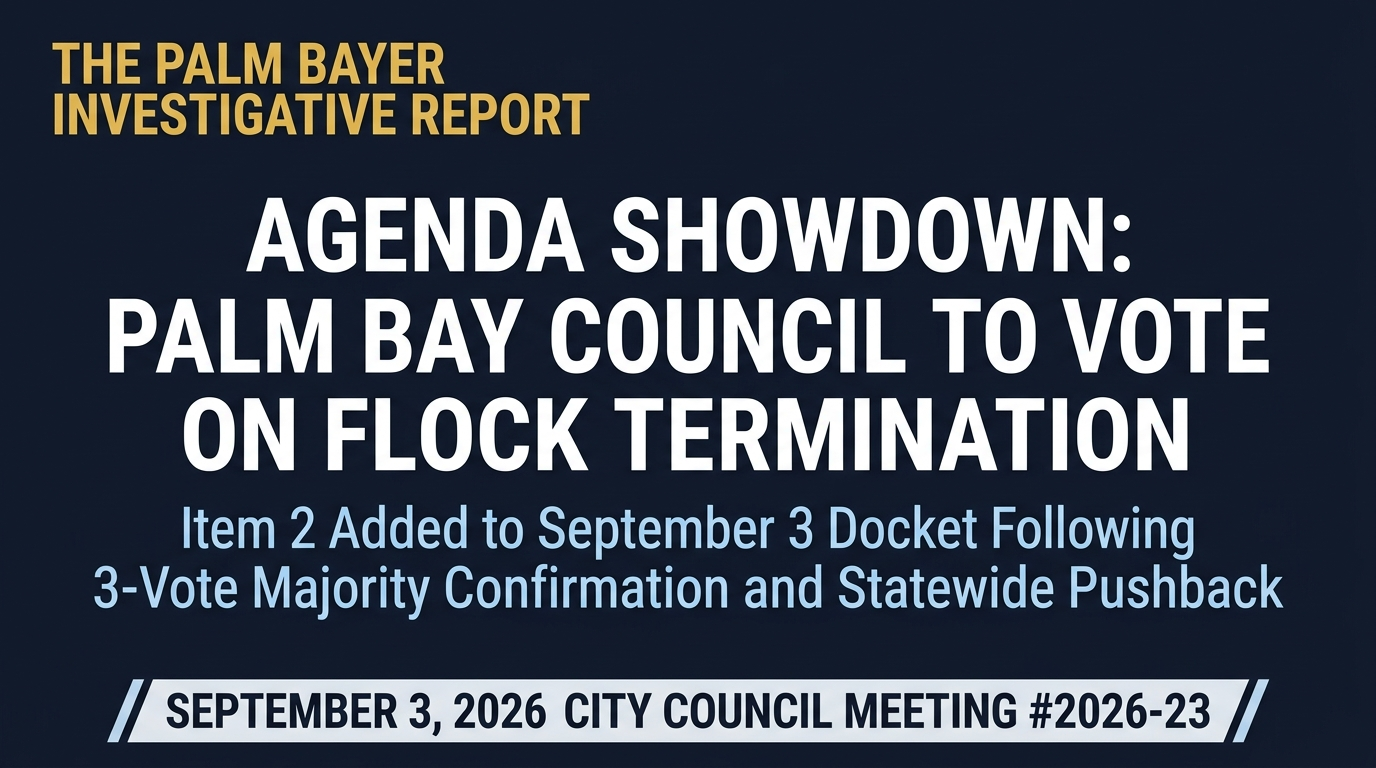
When the City of Palm Bay published its official agenda revisions for the September 3 regular meeting (Meeting 2026-23), Item 2 under New Business formally locked in the showdown: “Discussion of the FLOCK Automated License Plate Reader Camera System,” placed directly onto the docket by Councilman Kenny Johnson.
The agenda addition formally triggers a binding vote inside Council Chambers.
At the same meeting where Governor Ron DeSantis’s office will present a $3.5 million Florida Jobs Growth Grant check to develop the Compound industrial corridor under Proclamations Item 2, the dais is positioned to take decisive action to terminate Palm Bay’s 51-camera automated license plate reader network.
The Fox 35 Broadcast and the Confirmed 3-Vote Majority
The political collapse of the surveillance contract accelerated rapidly following an investigative report by Fox 35 Orlando digital producer Camille Sarabia. The broadcast confirmed that three council members have publicly declared deep reservations regarding the camera grid, creating a confirmed voting majority on the five-member dais.
Councilman Kenny Johnson (Seat 2) made his position unmistakable on the record, noting that community pushback against the network has become overwhelming.
“The majority of the feedback I’m hearing is to get rid of Flock,” Johnson told Fox 35. “It can be weaponized if it’s in the wrong hands, and I think that’s the biggest concern by residents and in our nation.”
When asked about taking local action if statewide legislation does not preempt the system first, Johnson declared his readiness to end the contract.
“I’m in favor of going ahead and removing them,” Johnson said. “That’s the will of the people.”
Johnson’s agenda placement represents the culmination of a systematic push for procurement oversight.
On August 20, Johnson sponsored the landmark municipal motion that slashed the city manager’s unilateral purchasing authority from $100,000 down to $25,000. That reform directly addressed findings by the Joint Legislative Auditing Committee (JLAC), closing the administrative loophole previously used to roll over recurring software subscriptions without standalone council votes.
Councilman Chandler Langevin (Seat 5) has served as the council’s Fourth Amendment anchor, warning that automated tracking networks establish a dangerous precedent.
“I’m very skeptical of these type of government network tracking system,” Langevin told Fox 35. “It can be a gateway to worse technology. You see what’s happening in China—the CCP with facial recognition and AI. It could eventually lead to something like that.”
Langevin called directly on state leadership for broader intervention, stating: “Let’s ban Flock cameras statewide.”
Following Governor DeSantis’s executive directive clearing unpermitted surveillance hardware from state rights-of-way, Langevin took to X to confirm his upcoming vote:
“Turns out, you can just do things!” Langevin posted. “We will definitely be discussing this item at our Thursday council meeting. I know how I’ll be voting!”
Deputy Mayor Mike Jaffe (Seat 3) provided a formal on-the-record statement to Fox 35 outlining his governance, compliance, and legal reservations:
“My hope when I raised my concerns was that the City would pause long enough to thoroughly verify compliance and allow time for the new governor election and the expected state legislation that more than likely preempt local government decisions,” Jaffe stated. “I support public safety, but not at the expense of process, compliance, or public trust.”
Councilman Mike Hammer (Seat 4), a fiscal conservative, has consistently questioned software contract bloat and demanded strict vendor quality benchmarks, warning against lowest-price procurement models and scrutinizing recurring technology expenditures.
That leaves Mayor Rob Medina (Seat 1) isolated on the dais.
Mayor Medina has been the lone vocal defender of the Flock network, insisting on the dais that “they’re license plate readers” rather than surveillance cameras, framing the August suspension as strictly a permitting matter, and authorizing the August 24 unhooding.
With at least three council votes publicly aligned to end the contract, Medina faces a clear choice on Thursday: cast an isolated dissenting vote or join a unanimous council action to cancel the system.
Readers can review our earlier investigative reporting on the August restart in our coverage of the unhooded camera dragnet and budget showdown.
Months of Citizen Testimony, Safety Audits, and Legal Scrutiny
The Thursday showdown is the culmination of months of sustained citizen testimony and regulatory scrutiny raised before City Council.
Pushback began long before the cameras became a regional headline.
As early as January 2025, resident Kristen Yontz (then Lanzana) brought questions to the dais regarding the Flock contract, later raising alarms during May and summer hearings about data privacy and expanding government surveillance.
During subsequent meetings, residents including Sheena Wallace pressed elected officials on public transparency, while former PBPD Deputy Chief Lance Fisher warned from the podium that the system had grown far beyond its original 2021 focus on stolen vehicles.
The controversy escalated in early August when citizen inquiries exposed that the city’s 51 camera poles had been installed across public rights-of-way without required signed and sealed engineering drawings under Florida law.
In response, City Manager Matthew Morton made the administrative decision on August 7 to immediately suspend the network and physically hood all cameras while staff conducted a comprehensive permitting audit.
The public comment podium during the August 20 council meeting captured the full spectrum of community debate while the cameras sat hooded.
Resident Deborah pushed back against claims that opposing automated surveillance undermined law enforcement, declaring that “anti-Flock is not anti-cop,” citing Fourth Amendment database standards, and urging council to cancel the contract.
Yontz returned to the podium to propose a community standard of “no mass surveillance without consent,” pressing staff on whether the city’s live-video “Condor” park cameras were also being audited.
Civic watchdogs emphasized that the police department’s investigative strength comes from sworn officers rather than automated algorithms, pointing out that detectives solve complex cases through boots-on-the-ground police work. Even supporters of the technology, like resident Robert Stice, acknowledged that while automated alerts can aid officers, proper administrative guardrails are essential.
On the dais, Councilman Kenny Johnson connected the controversy directly to procurement reform, arguing that had municipal purchasing thresholds been capped at $25,000 per state audit recommendations, the multi-year subscription would have required standalone council approval rather than administrative rollover.
After working with the vendor to review the installations and submit updated compliance paperwork, the city announced on August 24 that the permitting issues had been rectified and authorized staff to remove the hoods.
However, the testimony from August 20 made clear to the dais that resolving municipal right-of-way paperwork did not resolve the fundamental policy, fiscal, and constitutional questions surrounding automated vehicular tracking.
The Clean Contractual Exit: Section 441 Non-Appropriation
The legal mechanism for Palm Bay to walk away from Flock Safety without financial penalty is already engineered into municipal contract law.
Under Section 441 of Purchase Order #250583, combined with Article VII, Section 12 of the Florida Constitution, municipal contracts spanning multiple fiscal years are constitutionally contingent upon annual legislative appropriations.
A city council cannot legally bind future elected bodies to multi-year operating expenditures without an explicit annual appropriation.
To execute a clean, penalty-free termination, Council needs only to pass a formal motion instructing the city manager to withhold FY 2027 budget appropriations for the Flock ALPR program.
Providing a standard 30-day notice of non-appropriation under Section 441 immediately dissolves the contract, requires the vendor to remove all hardware from city rights-of-way at vendor expense, and protects the city from cancellation fees or breach-of-contract claims.
The administrative exit is airtight. The council holds the legal authority, the contractual clause, and the confirmed votes.
The Macro Collapse: Ivey, Putnam, and the DeSantis Doctrine
Palm Bay’s upcoming vote does not occur in a vacuum. It represents the final municipal domino falling in a rapid-fire, decisive statewide collapse of third-party automated surveillance grids.
What makes the collapse extraordinary is the sheer velocity at which it unfolded. In less than a week, state executive action and county law enforcement directives converged to leave Palm Bay’s camera network completely isolated.
The dominoes began falling when Governor Ron DeSantis issued an executive directive ordering the Florida Department of Transportation (FDOT) to clear unpermitted surveillance hardware from state rights-of-way, declaring the expanding camera grid “out of control.”
Then, on Monday, Brevard County Sheriff Wayne Ivey moved with swift decisiveness.
Sheriff Ivey abruptly terminated BCSO’s countywide Flock contract, ordered the immediate physical removal of thoroughfare camera poles from county roadways, and severed countywide database access.
Ivey’s directive went a step further by cutting off private and Homeowners Association (HOA) camera integrations from the sheriff’s dispatch matrix, dismantling the centralized data hub that previously monitored Space Coast motorists.
Less than 24 hours later on Tuesday morning, Palm Bay officially locked Item 2 onto its Thursday docket.
Across the region, agencies are recognizing the mounting operational redundancies, rising subscription costs, and legal liabilities of automated tag tracking, with jurisdictions like the Putnam County Sheriff’s Office similarly executing ALPR removals.
At the state legislative level, incoming Florida House Speaker Wyman Duggan is already coordinating statutory language modeled after New Hampshire’s strict privacy standard (NH RSA 261:75-b).
In plain terms, the New Hampshire standard flips the corporate surveillance model on its head through four core mandates:
- Ban on Roadside Pole Cameras: Stationary pole-mounted camera grids are prohibited. Devices are restricted exclusively to mobile law enforcement patrol vehicles.
- The 3-Minute Hard Purge: Any plate scan that does not match an active stolen vehicle, Amber Alert, or felony warrant must be permanently deleted within three minutes, preventing historical travel tracking.
- No Face or Passenger Scanning: Cameras are legally barred from photographing or recording drivers or occupants inside the vehicle.
- No Commercial Data Fusion: Private companies are prohibited from operating surveillance networks, hoarding citizen movements, or monetizing database access.
Crucially, this strict statutory framework is fundamentally incompatible with the business models of commercial ALPR vendors, whose venture-backed SaaS subscription profits depend entirely on maintaining persistent multi-week historical tracking databases, algorithmic pattern-of-life searches, and monetized cross-network data fusion.
Within days, the regional landscape completely transformed, setting up Thursday night inside Palm Bay City Hall as the decisive final reckoning.
Public Backlash and Citizen Participation
If city hall wanted a clear signal of community sentiment, the public record delivered it with overwhelming force.
An empirical sentiment analysis of 2,494 verified public comments scraped across regional broadcast reels from Spectrum News 13 revealed a staggering 97.2 percent anti-Flock rejection rate.
Residents repeatedly condemned the dragnet tracking of law-abiding drivers, the lack of transparency in vendor data custody, and the prioritization of cloud software over sworn patrol staffing.
The public outcry mirrors the passionate testimony delivered during recent council meetings, where citizens, civil liberties advocates, and constitutional scholars challenged the legality of warrantless travel logging.
Residents wanting to ensure their position is formally entered into the official meeting record ahead of Thursday’s vote can use our step-by-step civic guide on how to submit public comments for the official record and speak at City Council.
Written comments submitted to citycouncil@palmbayfl.gov and the city clerk become part of the permanent legislative packet for Meeting 2026-23. In-person speakers can sign up before the 6:00 PM gavel to address council directly under New Business Item 2.
The stage is now set for Thursday night.
With the agenda locked, the legal exit established, and a confirmed majority ready to act, the Palm Bay City Council has the opportunity to align municipal policy with constitutional principles.
The era of unchecked automated surveillance in Palm Bay faces its final vote Thursday, September 3 at 6:00 PM inside Palm Bay City Hall Council Chambers.