PALM BAY, FL (The Palm Bayer) — While City Hall in Palm Bay wrestles with internal forecasts projecting a $22 million to $44.5 million municipal revenue collapse under Florida Amendment 3, an audit of Brevard County records reveals a far larger fiscal convulsion waiting on the other half of every taxpayer’s bill.
On Saturday, September 19, Brevard County Supervisor of Elections Tim Bobanic deployed the first wave of 2026 general election ballots to military and overseas voters under the federal UOCAVA framework. This Thursday, September 24, under Florida Statute 101.62, the elections office begins dropping domestic vote-by-mail ballots into local mailboxes across the Space Coast. Voters marking their choices will encounter Amendment 3, pitched by state political leaders as sweeping property tax relief for primary homeowners.
Supporters of Amendment 3, championed by Governor Ron DeSantis and legislative leaders in Tallahassee, make an aggressive case for relief: between 2019 and 2024, statewide property tax collections across Florida surged from $31 billion to $55 billion as rapid real estate appreciation handed local governments historic revenue windfalls far outpacing population growth and inflation. Backers argue that expanding the homestead exemption to $250,000 establishes a crucial firewall against runaway tax assessments and escalating homeowners insurance premiums, forcing local county commissions to rein in discretionary expansion and operate within disciplined, private-sector-style budgets.
Inside the Brevard County Government Center in Viera, however, official records tell a stark operational story. Official county modeling presented to the Board of County Commissioners on August 4 exposes a structural deficit that will erase $87,020,400 in annual property tax revenue. That modeled projection represents an immediate 26% liquidation of the county’s ad valorem tax base once the full $250,000 exemption takes effect in 2028.
- The Core Deficit: Official Brevard County staff models confirm Amendment 3 will strip $87,020,400 per year from county operations, wiping out an estimated 26% of countywide property tax revenue.
- The Unconstitutional Offset: County leadership floated a 35% to 40% millage hike on non-homestead properties (businesses, renters, second homes) to absorb the loss. However, Article VII, Section 2 of the Florida Constitution bars differential tax rates, forcing any rate hike to fall uniformly while shifting the net burden entirely onto renters and employers.
- The $4 Million Transit Match Cliff: Space Coast Area Transit (SCAT) faces the loss of $2 million in local matching funds, forfeiting an equal 1:1 state block grant under FDOT TIP Project 442456-1 and opening an immediate $4 million operating chasm that federal law forbids closing through farebox revenues.
- The Paratransit Trap: Under 49 CFR 37.131, federal mandates prohibit reducing $54.92-per-trip paratransit services while maintaining fixed routes, forcing the county to cut high-ridership public bus lines first to legally contract its paratransit service boundaries.
- The Preemption Culmination: Over the past 15 years, state lawmakers stripped local control in 24 distinct policy areas, with 16 enacted since 2021 alone. Tallahassee took local zoning, planning, and regulatory authority; Amendment 3 now takes the operating cash.
For months, municipal debates in South Brevard focused on Palm Bay’s localized vulnerability. Because Palm Bay’s City Charter contains Section 6.01 and Section 6.02, which cap annual revenue increases and restrict emergency borrowing, the city faces a severe budget squeeze without statutory release valves.
County records confirm that the municipal crisis is merely the vanguard. The county government that provides regional jail capacity, judicial administration, emergency dispatch, arterial road maintenance, mosquito eradication, regional park operations, and public libraries is facing a fiscal cliff of unprecedented scale.
The $87 Million Ledger: Dissecting the 26% Revenue Collapse
During the August 4 Board of County Commissioners workshop in Viera, county administrative staff laid out the unvarnished mathematical impact of CS/HJR 1-F. The legislative resolution, passed during a June special session, raises the non-school homestead exemption to $150,000 on January 1, 2027, and to $250,000 on January 1, 2028, while cutting the non-homestead assessment increase cap from 10% to 5%.
Unlike state-mandated tax cuts in prior decades, Amendment 3 contains zero state replacement dollars, zero backfill formulas, and zero transition trust funds across its 20 enrolled pages.
The county’s internal financial model examined the exact revenue impact across all eight primary property-tax-funded accounts. When calculated at the full $250,000 exemption, the loss sums to a modeled total of $87,020,400 across eight audited county operating funds every single year:
| Operating Fund / Taxing District | Annual Property Tax Loss | Primary Operations Exposed |
|---|---|---|
| General Fund | $54,056,168 | Constitutional officers, sheriff operations, jail, courts, administration |
| Countywide Parks & Recreation | $7,213,588 | Regional parks, boat ramps, recreation centers, youth athletics |
| Law Enforcement MSTU | $7,332,504 | Unincorporated road patrol, precinct operations, criminal investigations |
| Fire Rescue MSTU | $6,017,240 | Advanced life support ambulances, fire suppression, rescue stations |
| Library District | $6,230,172 | 17 public library branches, digital media licensing, public computers |
| Mosquito Control District | $2,575,086 | Aerial spraying, larvicide treatments, vector disease surveillance |
| Road & Bridge District | $2,187,031 | Pavement resurfacing, right-of-way mowing, traffic signal maintenance |
| Environmentally Endangered Lands (EEL) | $1,408,611 | Prescribed burns, exotic plant removal, public sanctuary management |
| Total Annual County Revenue Loss | $87,020,400 | 26.0% of Total County Ad Valorem Tax Base |
The headline loss of $7,213,588 in the Countywide Parks and Recreation fund actually understated the total damage to community recreation. When factoring in Brevard’s four independent municipal service taxing units (North, Central, South, and Merritt Island recreation MSTUs), total recreation revenue eliminated across the county climbs to an estimated $18.6 million.
County administrative presentation slides delivered to the commission contained a blunt warning: “Just because a program is a ‘core service’ it is not held harmless.”
During the August 4 meeting, County Manager Jim Liesenfelt addressed the dais directly regarding services that residents assume are protected. On mosquito control, Liesenfelt pointed to the Florida Uniform Accounting System: “The definition is mosquito control is not a core service.”
That bureaucratic distinction carries profound public health consequences for a county flanked by the Indian River Lagoon and the St. Johns River marsh basin. Following the 2025 dengue fever alerts across Central Florida, Brevard County largely depleted its chemical operating reserves combating vector surges. Stripping $2.57 million from mosquito operations eliminates aerial spray flights and ground larvicide sweeps precisely when public health authorities warn of recurring mosquito-borne transmissions, including West Nile virus and dengue.
On community recreation, Liesenfelt outlined the immediate policy dilemma facing commissioners: “Do we raise the summer camp fees so high that people can’t afford to go to summer camp?” County staff worksheets indicated summer camp registration fees would have to surge into the $200 to $400 range per child just to keep community centers open.
The $1,408,611 cut to the Environmentally Endangered Lands program exposes an equally fragile structural liability. The EEL program, established by voter referendums to preserve sensitive scrub habitat and barrier island ecosystems, does not simply buy real estate; it is legally obligated to manage land already purchased. Land management requires certified burn crews for wildfire mitigation, regular invasive plant eradication, and perimeter fencing. Cutting operating funds creates an unmanaged fire hazard across tens of thousands of county-owned acres bordering suburban subdivisions.
The Legal Wall: Why the 35% to 40% Offset Plan Is Constitutionally Dead
Facing an $87 million crater, county administrative leadership offered commissioners what appeared on video to be a mathematical escape hatch.
“There is a way you could raise the millages on non-homesteaded properties to bring back the revenue to that point,” Liesenfelt told the board at the 20:33 mark of the August 4 workshop, “but it would be a 35 to 40% increase to the rates.”
Politically, the concept sounded seductive to elected officials: shield primary homeowners with the state’s new $250,000 exemption, while raising property tax rates on commercial parcels, second homes, and rental properties to replace the lost $87 million.
Legally, the proposal hits an immediate constitutional brick wall.
Article VII, Section 2 of the Florida Constitution contains the state’s strict Uniformity Clause: “All ad valorem taxation shall be at a uniform rate within each taxing unit.”
The Board of County Commissioners possesses zero legal authority to create a split-rate tax roll. It cannot adopt a 3.5-mill tax rate for owner-occupied houses and a 5.0-mill tax rate for apartment complexes, retail plazas, and industrial parks. A single, uniform millage rate must apply to all taxable property within the jurisdiction.
Furthermore, Brevard County Charter Section 2.9.3.1 imposes strict voter-approved revenue caps. Under the county charter, the Board of County Commissioners is prohibited from adopting a millage rate that increases budgeted ad valorem revenue over the prior fiscal year by more than the lesser of 3% or the Consumer Price Index, unless commissioners declare an “emergency or critical need” by a supermajority vote. While Florida Statutes Section 200.065 allows the rolled-back rate to rise to recover lost baseline dollars when taxable values collapse, any tax adjustment must be uniform.
The practical result is not a tailored corporate tax, but a massive tax shift engineered directly through the exemption structure itself.
If the county increases its uniform millage rate to claw back any portion of the $87 million deficit, homesteaded homeowners are insulated by the expanded $250,000 exemption. Non-homesteaded properties receive no such shield. Every dollar of millage expansion falls squarely on rental properties, commercial businesses, and industrial facilities.
Who actually pays that bill? In Brevard County, where renters occupy roughly 25% of all residential housing units, tenants will bear the brunt. Extensive national economic studies on property tax incidence demonstrate that landlords pass between 60% and 80% of local property tax increases directly to residential tenants through higher monthly rents during lease renewal cycles. Commercial tenants operating under standard “triple-net” leases, where the small business pays the building’s property taxes, insurance, and maintenance, will see monthly tax surcharges climb overnight.
The proposal does not eliminate taxes. It shifts the operating cost of local government from suburban homeowners onto young families renting apartments, hourly wage earners, and local storefront retailers.
The Transit Match Cliff: SCAT’s Double-Hit and the Paratransit Trap
Nowhere is the structural collapse of Amendment 3 more immediate or legally tangled than inside Space Coast Area Transit (SCAT).
During the August 4 meeting, Liesenfelt explicitly warned the dais of an imminent transit loss: “Right now we have a little over $2 million a year going to the transit services. That money would disappear. They use that as their match.”
The loss does not stop at $2 million.
Public transit in Florida relies on heavily interlocked intergovernmental financing. Under the Space Coast Transportation Planning Organization (TPO) FY 2027-2031 Transportation Improvement Program, Project 442456-1 schedules the Florida Department of Transportation (FDOT) Public Transit Block Grant at exactly $1,998,604 in state funds. By statutory mandate, the FDOT block grant requires a strict 1:1 local cash match ($1,998,604).
When Brevard County eliminates its $2 million local contribution to balance its general budget, it simultaneously forfeits the $1.998 million state match. The $2 million local cut instantly detonates into a $4 million operating hole.
Transit administrators cannot simply hike bus fares to replace the lost funding. SCAT’s base fare is $1.50, and systemwide farebox recovery sits at just 9.45%, according to the FTA National Transit Database profile. More importantly, Title 49 of the United States Code expressly prohibits transit agencies from using passenger farebox revenues as the required local match for federal operating grants.
Then comes the federal legal floor.
Under 49 CFR Section 37.131, the Americans with Disabilities Act mandates that every public entity operating a fixed-route transit system must provide complementary paratransit service to individuals with disabilities. Federal regulations require this service to operate within a three-quarter-mile corridor on each side of every fixed bus route, as well as a three-quarter-mile radius around route terminal points, with mandatory next-day scheduling.
SCAT’s demand-response paratransit service costs $4.84 million annually, averaging $54.92 per passenger trip, with a negligible 5.96% farebox return.
Under federal civil rights law, SCAT cannot trim paratransit routes while leaving adjacent fixed bus routes active. The agency cannot legally state that paratransit vans will stop serving disabled residents along Palm Bay Road or New Haven Avenue if regular city buses continue rolling past their neighborhoods.
The only legal method for SCAT to reduce its paratransit financial obligation is to completely dismantle the underlying fixed bus routes. By terminating fixed routes, the agency legally shrinks its mandatory three-quarter-mile corridor. To survive an operating cut, SCAT must eliminate the high-ridership, fixed-route buses carrying hundreds of thousands of commuting workers, students, and seniors, simply to shed the federal obligation to run paratransit vans.
This dynamic arrives on top of an already deepening transit crisis on the coast. In August, local officials learned that FDOT will not renew a $1.4 million corridor funding stream supporting Route 4 and Route 9 (the SR 520 connector and the A1A Beach Trolley), as reported by Florida Today. That grant non-renewal represents a scheduled statutory sunset under Florida Statute 341.031(8), which caps state transit service development demonstration grants at three years.
Together, Routes 4 and 9 carried 469,207 passenger trips in FY 2024-2025, accounting for 26% of SCAT’s entire bus ridership. Service cuts along the barrier island will strand hospitality, service, and healthcare workers who rely on public transit to reach jobs in Cocoa Beach and Cape Canaveral, compounding the broader $4 million transit shortfall triggered by Amendment 3.
The 15-Year Whittling: From Zoning Seizure to Revenue Starvation
Advocates in Tallahassee frame Amendment 3 as an organic, standalone tax measure designed to restrain local government growth. State records reveal a very different reality: Amendment 3 is the culmination of a systematic, 15-year legislative assault on local home rule.
Between 2011 and 2026, the Florida Legislature enacted 24 major preemption statutes that progressively stripped power away from county commissions and city councils. Notably, 16 of those 24 preemptions were concentrated between 2021 and 2026 alone.
For more than a decade, the state whittled away local authority piece by piece:
THE 15-YEAR PREEMPTION ARC: TALLAHASSEE VS. LOCAL CONTROL
----------------------------------------------------------------------------------
2011: HB 45    | Preempted firearm regulation; personal $5K fines for officials.
2011: HB 63    | Stripped local authority to regulate vacation rentals.
2011: HB 7207  | Gutted mandatory transportation, school, and park concurrency.
2013: HB 655   | Barred local governments from mandating sick leave or benefits.
2019: HB 1159  | Banned local permits or replanting rules for residential trees.
2021: HB 337   | Capped local impact fee increases to protect private developers.
2021: HB 401   | Barred local architectural and design standards on single-family homes.
2021: HB 919   | Banned cities from restricting utility fuel types or clean energy choices.
2021: HB 735   | Eliminated local occupational licensing for specialty trades.
2021: HB 1059  | Imposed statutory fee refunds if local building permits miss deadlines.
2023: SB 102   | Live Local Act: Overrode local zoning, density, and height controls.
2023: SB 170   | Mandated business impact statements; allowed legal fee awards against cities.
2024: HB 433   | Preempted local worker heat-safety standards and fair scheduling rules.
2025: SB 1080  | Mandated strict permit shot clocks with mandatory application fee refunds.
2025: SB 180   | Prohibited post-hurricane building moratoria within 100 miles of storms.
2026: HB 1389  | Expanded Live Local zoning overrides to municipal and school board lands.
----------------------------------------------------------------------------------
2026: AMENDMENT 3 (CS/HJR 1-F)
Tallahassee spent 15 years stripping local elected officials of zoning, planning,
and regulatory authority. Amendment 3 now takes the operating revenue.
The legislative sequence reveals a clear strategy. First, the state eliminated local land-use planning controls by deregulating concurrency in 2011. Next, it restricted development fees through the 2021 impact fee caps. Then, through the sweeping Live Local Acts of 2023, 2024, 2025, and 2026, the state nullified local zoning authority, forcing cities and counties to administratively approve dense, multi-story developments in commercial zones without public hearings or city council votes.
Having stripped local governments of the ability to regulate growth, control traffic concurrency, or mandate developer contributions, the Legislature returned in the 2026 Special Session with CS/HJR 1-F to strip their operating revenue.
Local governments were ordered to accommodate rapid population growth, widen roads, process building permits on expedited shot clocks, and provide emergency services, while Tallahassee systematically dismantled the revenue streams required to fund them.
The Blue-and-Red Fracture: First Responders Break Ranks
The sheer financial magnitude of Amendment 3 has triggered an extraordinary political rupture across Florida.
Typically, law enforcement unions and county sheriffs align closely with conservative state leadership on fiscal policy. On Amendment 3, first responders across Florida have broken ranks, organizing an unprecedented campaign in uniform against a measure backed by Governor Ron DeSantis and formally endorsed by the Republican Party of Florida.
The Florida Sheriffs Association (FSA), the Florida Fraternal Order of Police, and the Florida Professional Firefighters have all taken public stances against Amendment 3.
Sheriff Billy Woods of Marion County, serving as FSA President, issued an explicit public warning on the measure: “Less deputies, slower 911 response, and ultimately more crime.” Woods noted that his own department faces an estimated $54 million operational loss if the amendment passes, as county sheriffs mobilized statewide.
In Polk County, Sheriff Grady Judd publicly described the amendment as a “train wreck.” Volusia County Sheriff Mike Chitwood warned that the state’s promotional pitch “sounded too good to be true.” In South Florida, Palm Beach County Sheriff Ric Bradshaw pointed out the inescapable arithmetic facing constitutional officers: “85 percent of your budget is personnel… if budgets have to be cut, it’s going to be people.”
The political campaign surrounding the ballot measure reflects a massive financial imbalance.
The “Vote Yes on 3” political committee received an immediate $10 million war chest from Florida Realtors, chaired by CEO Margy Grant. Proponents point to surging property tax collections across Florida, which rose from $31 billion in 2019 to $55 billion in 2024, arguing that local governments are flush with cash and must be forced by constitutional mandate to tighten their belts. Governor DeSantis and Representative Monique Miller (R-Palm Bay) have actively stumped for the measure, framing it as vital relief for homeowners struggling against general inflation and property insurance spikes.
However, forensic budget audits reveal the fatal flaw in that top-line argument: more than 65% of Florida local governments’ revenue expansion since 2019 was immediately absorbed by double-digit spikes in public sector property and liability insurance premiums, state-mandated increases in Florida Retirement System (FRS) employer contribution rates, hyper-inflation in road and water pipe materials, and the need to hire additional emergency medical personnel to keep pace with hundreds of thousands of new residents. Slashing operating revenues does not roll back these fixed operational cost escalations; it forces counties into sudden, disorderly service shutdowns.
In contrast, the two political committees formed to oppose the amendment have raised barely $124,000 combined, relying almost entirely on earned media, press conferences by uniformed first responders, and local government resolutions.
Public polling on the amendment remains fragile and deeply contested. While Sachs Media released surveys in June and August showing 63% to 64% voter support, just above the 60% constitutional approval threshold, those polls contained a major methodological flaw: they tested ballot language that the courts had already thrown out.
On August 14, 2026, Leon County Circuit Judge David Frank ruled that the Legislature’s original ballot title, “Save Our Homes from Excessive Property Taxes,” was “clearly and conclusively defective” and misleading, ordering the Division of Elections to rewrite the ballot title and summary to reflect neutral mechanics.
Four days after the court struck down that deceptive title, Sachs Media polled voters using the outlawed “Save Our Homes” phrasing. The revised, neutral ballot language that voters will actually read in their mailboxes this week strips away the political branding, presenting only the mechanical reality of higher exemptions, a 5% commercial cap, and local spending restrictions.
Municipal Dominoes and the Regional System Mirage
As Brevard County contemplates an $87 million loss, South Brevard’s largest city is already scrambling for lifeboats.
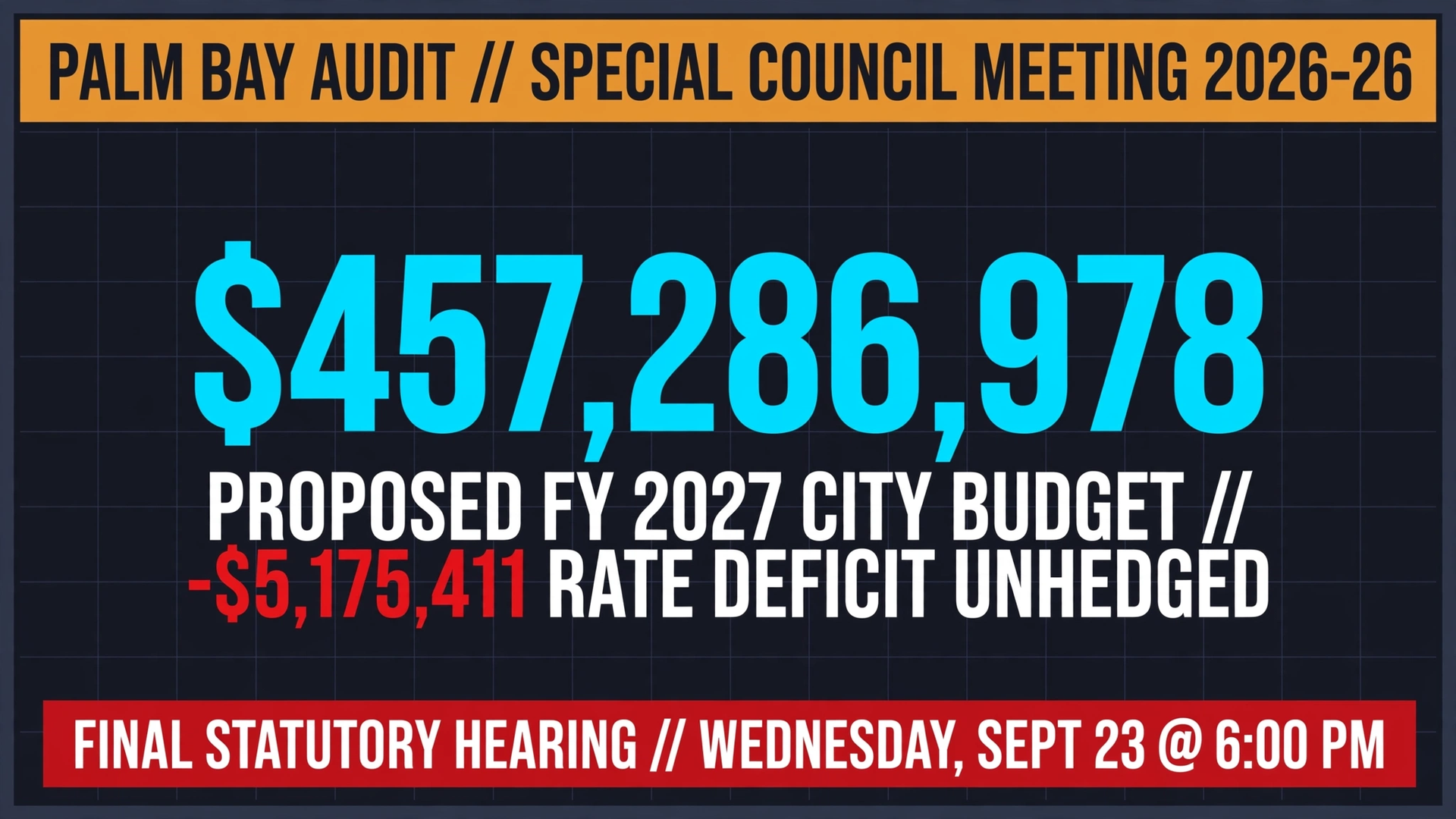
On August 3, Palm Bay’s Citizens’ Advisory Task Force reviewed economic modeling projecting that Amendment 3 will strip $22 million from the city’s General Fund in FY 2027, compounding to an annual recurring deficit of $44.5 million by 2031. For a city whose General Fund relies on property taxes for $70.48 million (52% of total revenue) and dedicates $76.58 million (56.4%) to public safety, a $44.5 million cut represents the functional liquidation of non-police municipal operations.
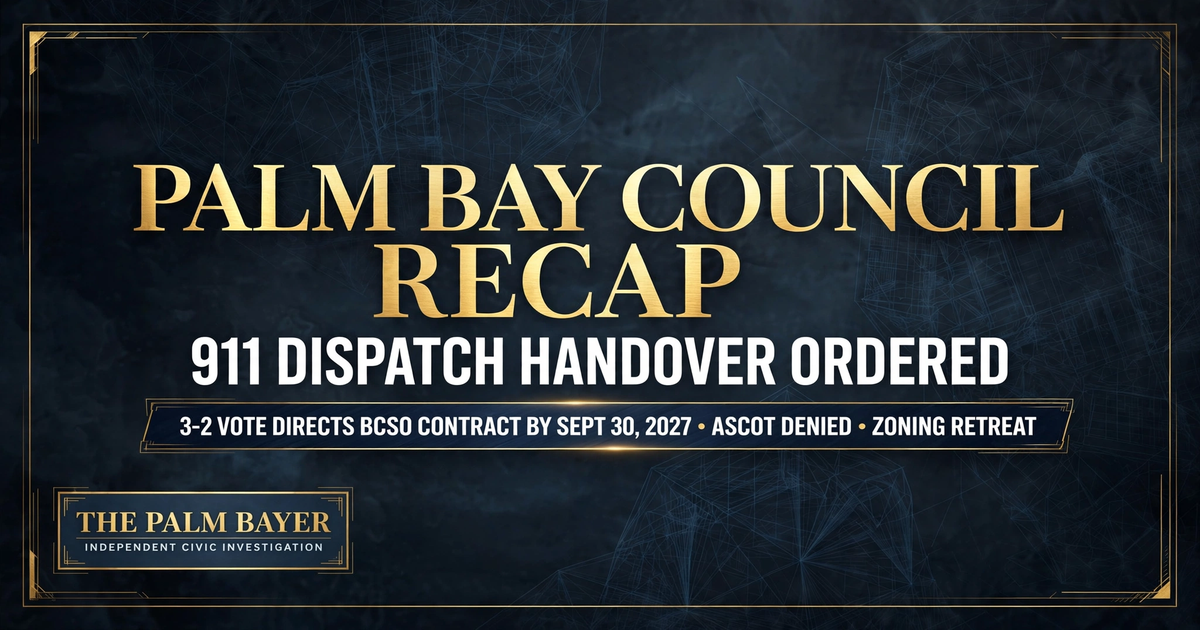
On September 17, the Palm Bay City Council voted 3-2 to direct City Manager Matthew Morton to negotiate an interlocal agreement transferring the city’s entire 911 emergency communications division to Brevard County Sheriff Wayne Ivey, according to official council agenda records.
Under the draft agreement, Palm Bay would surrender 27 dispatch positions, pay $70,000 to relocate dispatch consoles, and convey six L3Harris Symphony consoles to the Sheriff for zero dollars. In exchange, the Sheriff’s Office agreed to waive dispatch service fees in Year 1, charging $520,000 in Year 2, $520,000 in Year 3, and $545,000 in Year 4, yielding a projected net city savings of roughly $2.8 million annually, as detailed in The Palm Bayer’s dispatch contract investigation.
Regional consolidation is often touted as the ultimate efficiency remedy for municipal tax losses. Three months before Palm Bay’s vote, the City of Cocoa voted on June 9 to transfer its dispatch operations into Brevard’s unified communications system, securing roughly $1.3 million in annual savings.
The fundamental flaw in relying on county consolidation as an Amendment 3 survival strategy is that the county itself is bleeding out.
In Brevard County, the municipal services most severely threatened by Amendment 3 are already regionalized. Brevard’s 17 public library branches are not run by individual cities; they are funded through the countywide Library District. Regional parks, community centers, and athletic complexes are already county operations. The Law Enforcement MSTU and Fire Rescue MSTU are already unified regional divisions.
When the county faces an $87 million deficit, there is no higher tier of local government to absorb the shock.
Furthermore, the language of Amendment 3 introduces severe legal ambiguities regarding what local governments can even spend property taxes on. CS/HJR 1-F restricts ad valorem revenues to enumerated categories: public safety, education, infrastructure, natural resources, debt service, pensions, and general administration.
The Florida Association of Counties has warned that this restrictive list could legally bar counties from using property taxes to fund public libraries, maintain community parks, or operate animal shelters. While legislative drafters inserted Category (g), a catch-all permitting other expenditures approved by local governing bodies “except those prohibited by general law,” that language remains completely untested in Florida courts. Under legal canons of statutory construction like ejusdem generis, judges could easily rule that non-enumerated discretionary programs cannot be funded with property tax dollars.
Finally, the amendment contains a glaring structural carve-out that will shock homeowners when TRIM notices arrive in August 2027.
Public school operational levies are completely excluded from Amendment 3. School districts will maintain only the standard $25,000 baseline homestead exemption. Because local school board millage accounts for roughly 40% of the typical Brevard County property tax bill, school taxes will continue to rise with rising property values, even as city and county services are severely curtailed.
Homeowners expecting their overall tax bills to plunge will discover that while their parks, libraries, transit lines, and road resurfacing projects were gutted, their total savings were blunted by an untouched school tax levy and higher municipal user fees.
As mail ballots arrive across Brevard County over the next 72 hours, voters are not simply deciding whether to grant themselves a property tax discount. They are voting on whether to permanently dismantle $87 million in county services, push local transit into an unrecoverable regulatory tailspin, shift the municipal tax burden onto local renters, and finalize Tallahassee’s fifteen-year campaign to eliminate civic self-governance.