PALM BAY, FL (The Palm Bayer) — When the Palm Bay City Council convenes Special Council Meeting 2026-26 on Wednesday night for its final statutory budget hearing, the dais will confront an unresolved mathematical dilemma: the official spending plan up for final adoption still counts millions of dollars in revenue from utility rate increases that Council explicitly killed two weeks ago.
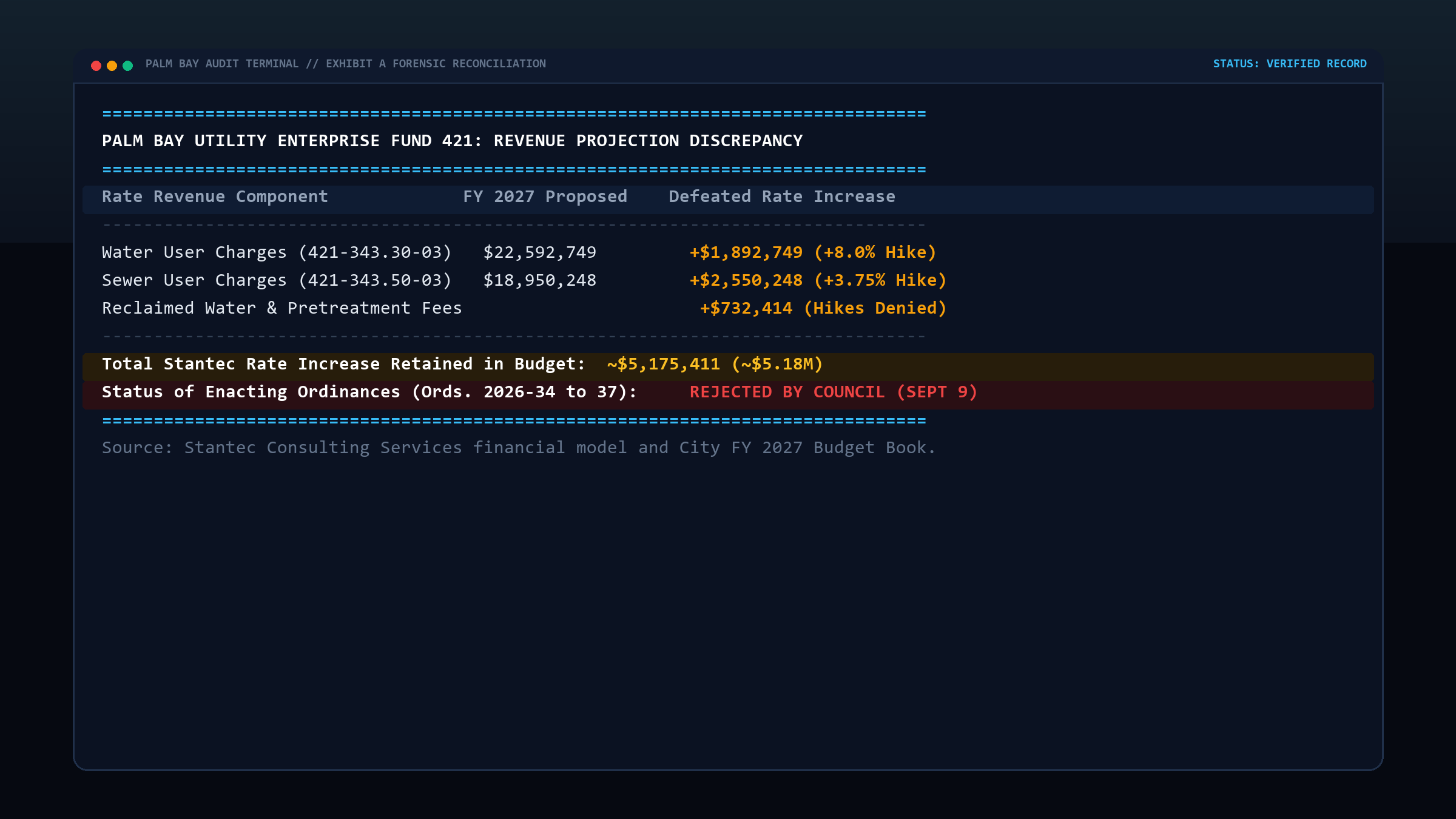
On September 9, Council voted in rapid succession to reject all four utility measures on First Reading. According to official roll-call records, Ordinance 2026-34 (water and wastewater impact fees) was denied 4-1 with Mayor Rob Medina dissenting, rejecting proposed capacity fee increases on new development and creating a separate capital-side revenue constraint. Immediately following, Council took up Ordinances 2026-35 (water and sewer user rates), 2026-36 (sewer use and pretreatment), and 2026-37 (reclaimed water rates) on motions to deny. While Mayor Medina did not voice a vote on those three measures, Palm Bay City Council procedural rules dictate that any vote not cast by a member present is legally recorded in the affirmative. Because the motions on the floor were to deny, the unvoiced votes joined the prevailing side, transforming what were called as 4-0 tallies into unanimous 5-0 votes to kill the rate hikes. That collective action shut down the operational rate package designed by Stantec Consulting Services Inc., eliminating an estimated $5.18 million in projected operating revenue increases for the municipal water and wastewater utility enterprise fund.
Yet the official legislative record reveals a striking procedural disconnect. According to official verbatim meeting transcripts, the roll-call vote approving Ordinance 2026-38 on First Reading concluded exactly 38 seconds after Council defeated the final utility rate increase (Ordinance 2026-37 at 03:21:02 and Ordinance 2026-38 at 03:21:40).
In those 38 seconds, no adjustments were made to the accompanying budget documents to reflect the loss of that utility revenue.
Now, the city administration has published its official 243-page agenda packet for the September 23 final hearing. Attached to Ordinance 2026-38 as Exhibit “A” is the 98-page “FY 27 Proposed Budget with Changes Book.”
A direct line-item comparison between the proposed budget with changes book and Exhibit “A” confirms that the city carries forward the same revenue lines without reduction. The water revenue projection remains booked at $22,592,749, predicated on the defeated 8.0 percent rate hike. The sewer revenue projection remains booked at $18,950,248 (Account 421-0000-343.50-03), calculated by multiplying the FY 2026 year-end estimate by exactly 1.0375.
Across the entire 98-page document, the only operational amendment recorded inside the Utilities Operating Fund is a $41,503 balancing adjustment to fund one-third of the personnel cost for a reclassified Community Engagement and Content Strategist.
The $5.18 million revenue shortfall sits completely unhedged on the final reading docket.
Under Florida municipal accounting standards, enterprise funds are established to operate as self-supporting proprietary entities, funded through user rate charges rather than ad valorem property tax subsidies.
Unless Council amends the ordinance on the dais Wednesday night by ordering equivalent expenditure reductions or authorizing a specific fund-balance cash drawdown, members will be enacting a $457.3 million citywide budget that carries an uncorrected $5.18 million structural hole on day one of the fiscal year.
The Fee Resolution Audit: Targeted Adjustments Disprove Broad Backfill
Before Council takes up the final budget ordinance, the agenda schedules six consecutive fee resolutions, designated Resolutions 2026-14 through 2026-19.
An exhaustive line-by-line audit of the exhibits attached to these resolutions disproves any speculation that municipal administration quietly attempted to backfill the $5.18 million utility hole through broad, across-the-board fee increases on residents. Instead, the documents reveal that the vast majority of municipal fees are being re-adopted with zero changes, while adjustments in other areas are narrowly targeted to commercial contractors and developers.
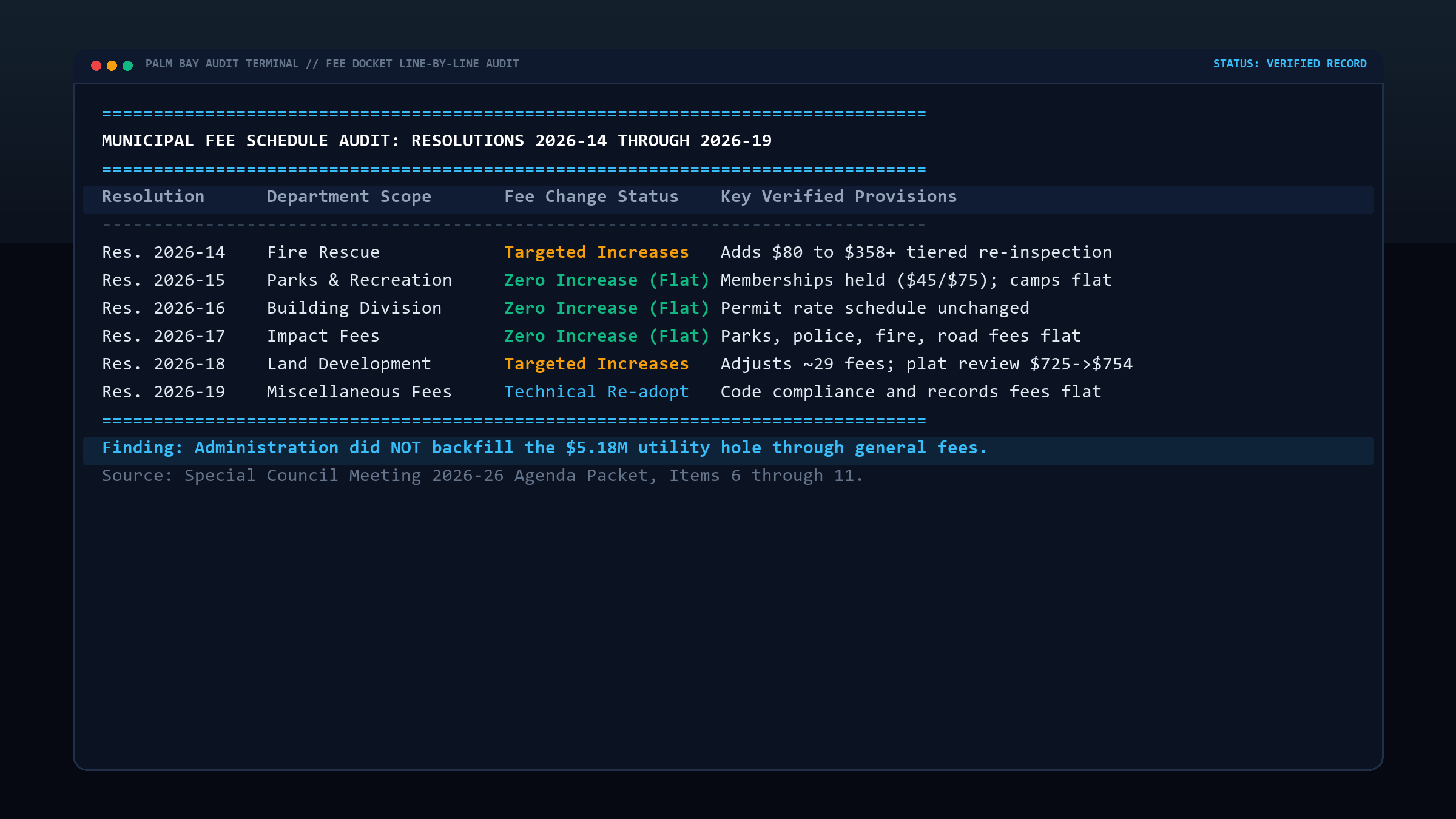
Three of the six resolutions represent complete, flat re-adoptions:
Resolution 2026-15, governing the Parks and Recreation Department, maintains all existing user rates without increase. Annual memberships at city community centers remain locked at $45 for youths and seniors, $75 for adults, and $45 for additional family members. Registration costs for youth summer camps, after-school childcare programs, athletic field rentals, and pavilion reservations remain frozen at their current levels.
Resolution 2026-16 re-adopts the Florida Building Code fee schedule for the Building Fund without raising permit fees, maintaining existing schedules across all commercial and residential building tiers.
Resolution 2026-17 re-adopts the city’s impact fee schedules for parks, police, fire, and transportation facilities for fiscal years 2027 through 2028 without rate increases, continuing the statutory rate structures established in prior municipal studies.
Where fee adjustments do appear, they are targeted strictly to operational cost recovery for specialized regulatory services:
Resolution 2026-18, establishing fees under the Land Development Code, modifies approximately 29 technical line items paid by subdivision developers and commercial builders. Notable adjustments include raising surveyor plat review charges from $725 to $754, increasing engineering inspector hourly billing rates from $20 to $24 per hour, and shifting the public improvement inspection administrative charge from 0.6 percent to 0.7 percent of certified construction valuation.
Resolution 2026-14 updates Fire Rescue prevention fees, establishing a tiered first re-inspection fee schedule ranging from $80 for small commercial spaces under 2,500 square feet to $358 or more for industrial complexes exceeding 50,000 square feet. It also establishes standardized inspection fees for mobile food dispensing vehicles.
These audited fee resolutions demonstrate that the administration did not construct an alternate revenue vehicle to absorb the utility deficit. The six resolutions handle routine administrative cost recovery, meaning the $5.18 million utility shortfall remains entirely exposed.
The Infrastructure Divide: Utilities Commands 79% of Funded Capital, General Fund Zeroed Out
The sharpest fiscal contrast in the budget packet appears in Resolution 2026-21, which formally adopts the Five-Year Capital Improvements Program (CIP) for fiscal years 2027 through 2031.
The multi-year CIP totals $738,043,463 across all funds over the five-year planning window. When prior-year carryforwards and active continuous appropriations are added, the total capital commitment reaches $814,236,839.
For FY 2027, the city administration has scheduled $118,335,563 in funded capital expenditures across all municipal funds, a figure that includes a minor $19,875 mathematical footing variance in the city’s published summary table.
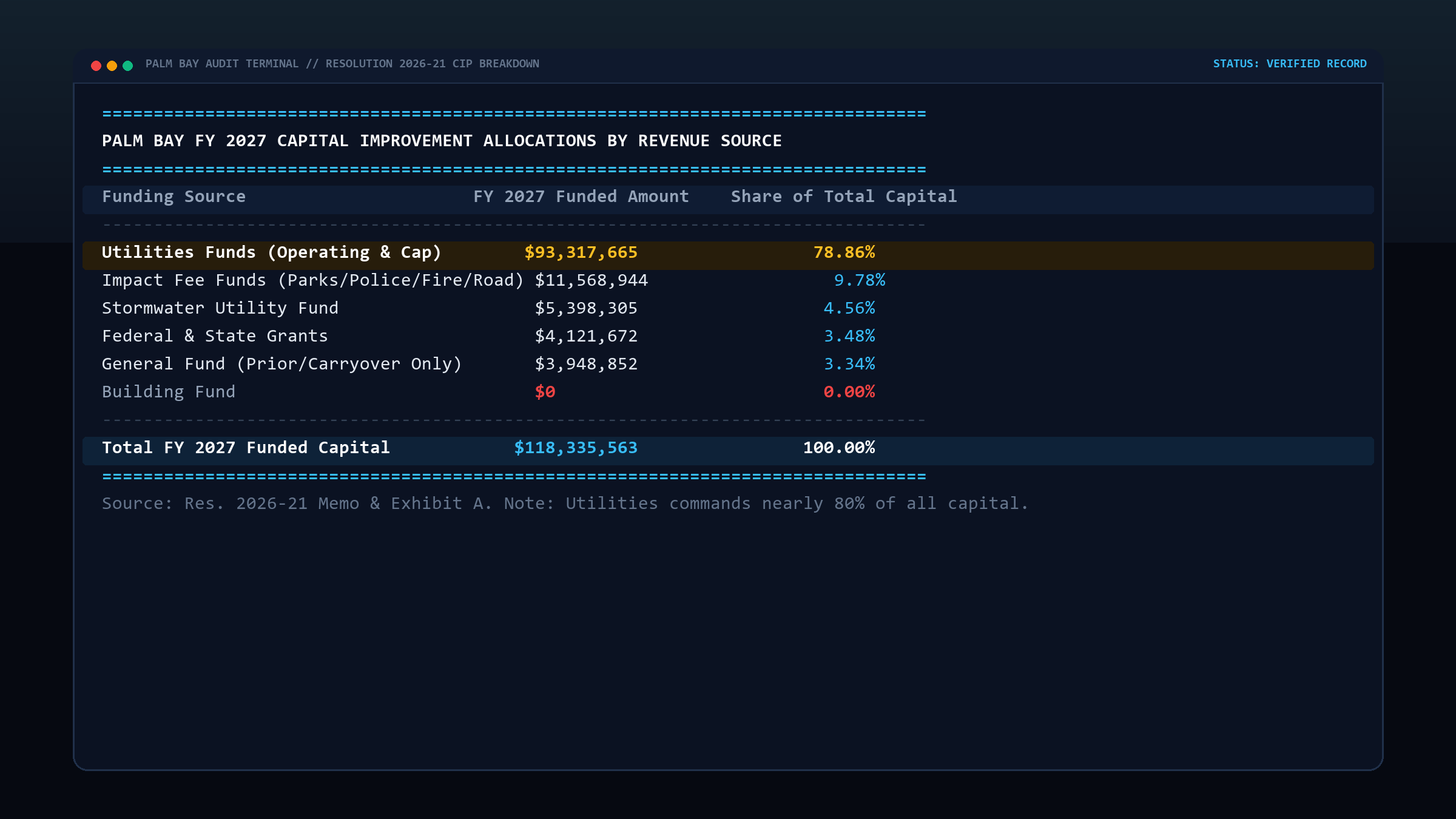
A detailed examination of project allocations demonstrates where the city’s financial machinery is concentrated: the Utilities Fund absorbs $93,317,665, representing 78.9 percent of every single dollar of funded capital in the city for FY 2027.
By stark contrast, frontline general government departments faced a total shutout for new capital projects.
During the summer budget development process, municipal department heads submitted formal requests totaling $15,840,980 for new capital initiatives to be funded out of the General Fund. These requests reflected pressing operational needs across eight operational divisions:
- Palm Bay Fire Rescue: Requested $8,389,785 for station hardening, apparatus replacement, and emergency facility upgrades.
- Palm Bay Police Department: Requested $3,721,853 for critical operational technology, fleet vehicles, and physical security enhancements.
- Parks and Recreation: Requested $1,868,680 for neighborhood park rehabilitation, playground safety improvements, and athletic court restorations.
- Public Works (General Fund Operations): Requested $1,568,723 for municipal facility maintenance, drainage connectivity, and rights-of-way repairs.
- Information Technology: Requested $135,950 for enterprise network infrastructure.
- Growth Management: Requested $77,542 for technical planning systems.
- Procurement: Requested $43,281 for contract management modules.
- Human Resources: Requested $35,166 for compliance systems.
The administration’s funded allocation for those departmental requests was uncompromising: every single request was zeroed out. The total funded amount for new General Fund capital requests in FY 2027 is exactly $0, representing a 0.0 percent funding rate.
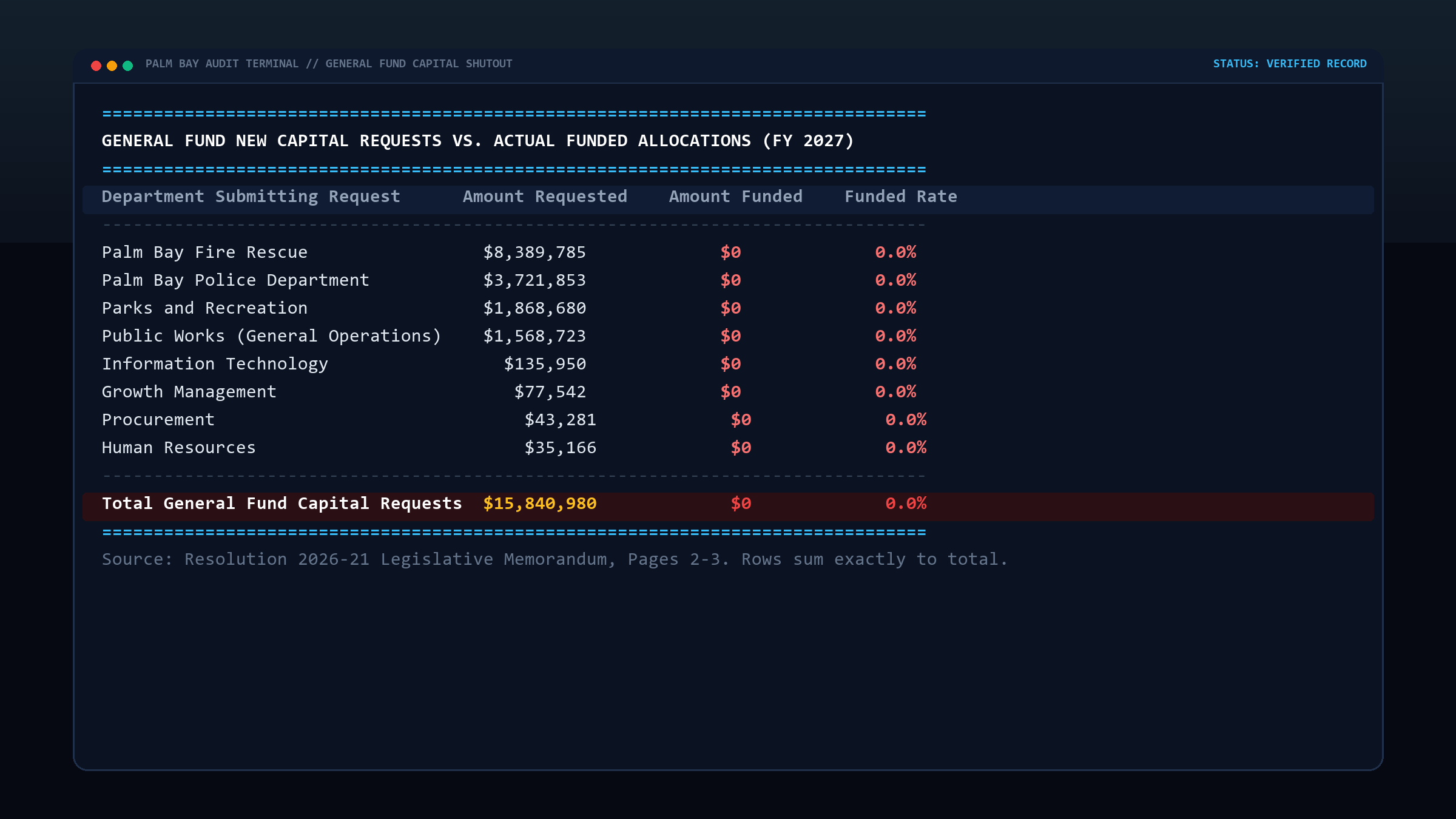
The only General Fund capital dollars appearing on the FY 2027 ledger ($3,948,852) represent prior-year reallocations and carryover commitments rather than new project authorizations. No fresh ad valorem tax dollars are being directed toward capital equipment or facility expansion for emergency services.
Stantec’s Warning: Credit Ratings and the $277M Debt Mountain
The overwhelming concentration of capital dollars inside the utility enterprise highlights why the September 9 vote to kill rate increases created such significant friction between the dais and administrative leadership.
During the September 9 hearing, Stantec Consulting Services project manager Peter Napoli delivered an extensive technical presentation detailing the utility system’s long-term capital liability. Over the life of the master capital plan, the utility system accounts for $485,234,464, or 59.6 percent of the city’s total multi-year capital program.
More critically, Napoli testified that $277 million, representing 92.4 percent of Stantec’s $300 million rate-study capital improvement plan (which sits within the city’s broader $448.9 million five-year utilities CIP schedule), must be financed through the issuance of municipal debt and state revolving fund loans.
The utility capital program is dominated by two massive regional facility expansions:
- North Regional Water Treatment Plant Expansion: Phase 1 requires an estimated investment of $110 million to $115 million, with total project costs projected at $231 million. This expansion integrates reverse osmosis treatment technology necessary to comply with federal Environmental Protection Agency (EPA) drinking water standards governing per- and polyfluoroalkyl substances (PFAS), which establish strict limits of 4.0 parts per trillion.
- South Regional Water Reclamation Facility Expansion: Phase 1 requires $25 million in initial financing, with complete system expansion budgeted at $85 million to handle rapidly accelerating wastewater volumes from commercial and residential construction in the southern sectors of the city.
In his testimony before Council, Napoli warned that freezing water and sewer rates depresses the utility system’s debt service coverage ratio toward the bond covenant operational floor of 1.0.
To secure favorable borrowing terms on revenue bonds, institutional credit rating agencies typically look for a debt service coverage ratio between 1.5x and 2.0x. Allowing the ratio to slip toward 1.0 risks credit rating downgrades, which would translate into increased borrowing costs for Palm Bay taxpayers when bonds are priced.
The dilemma for Council is acute: while members voted to protect utility customers from immediate monthly bill increases, they did not scale back the capital obligations driving the revenue demands.
Ad Valorem Millage: The Rolled-Back Rate and Property Tax Yields
While utility financing remains contentious, the property tax side of the ledger proceeds under strict Florida Truth in Millage (TRIM) statutory boundaries.
Under Resolution 2026-22, Council will formally adopt the city’s ad valorem tax rates for FY 2027. The resolution establishes the operating millage rate at 6.6015 mills.
This rate is mathematically identical to Florida’s certified rolled-back rate, representing a 0.00 percent TRIM tax increase. The operating rate is reduced by 0.0985 mills from the FY 2026 operating rate of 6.7000 mills.
The decision to adopt the rolled-back rate took shape during Council’s July 7 budget workshop. With Councilman Chandler Langevin absent from that session, Councilmen Kenny Johnson and Mike Hammer supported tax restraint. Under Florida Statutes Section 200.065, a two-thirds majority (four affirmative votes on a five-member council) is required to adopt a millage rate above the rolled-back rate, meaning the votes needed to advance an above-rollback rate were not present.
Adopting the rolled-back rate does not mean property tax revenue remains flat.
Because the Brevard County Property Appraiser certified Palm Bay’s gross taxable operating valuation at $11,098,266,589, an expansion of more than $730 million driven by $548.6 million in new taxable construction, the 6.6015 rolled-back rate will produce $70,479,634 in net operating revenue. That represents an increase of $3,628,624, or 5.4 percent, over actual operating property taxes collected in FY 2026.
In addition to operating millage, Resolution 2026-22 sets the voter-approved debt service millage for the city’s General Obligation road paving bonds at 0.9385 mills, assessed against a certified debt valuation of $11,112,964,435. That rate is reduced from 0.9993 mills last year and will generate $10,012,336 dedicated exclusively to debt service on road reconstruction bonds.
Combined, Palm Bay’s direct municipal property tax rate stands at 7.5400 mills (down from 7.6993 mills in FY 2026), producing $80,491,970 in direct levy yield. Across all city funds, total budgeted property taxes reach $80,569,094, with the remaining $77,124 reflecting community redevelopment ad valorem allocations.
| Tax Levy Category | Adopted Millage | Certified Taxable Valuation | Budgeted Levy Yield |
|---|---|---|---|
| City Operating Millage (TRIM) | 6.6015 mills | $11,098,266,589 | $70,479,634 |
| Voted Road Bond Debt Millage | 0.9385 mills | $11,112,964,435 | $10,012,336 |
| Total Direct Council Levies | 7.5400 mills | N/A | $80,491,970 |
| All-Funds Property Tax Total | (Includes $77,124 CRA) | N/A | $80,569,094 |
Source: Resolution 2026-22, Florida DR-420, and FY 2027 Budget Book Page 5.
Discretionary Pressure: Recreation Budget Slashed 39% While Legacy Costs Escalate
The reason that $3.63 million in new property tax revenue failed to fund new General Fund capital projects is that fixed personnel obligations absorbed the city’s revenue growth before the budget reached the dais.
As documented in the FY 2027 Proposed Budget with Changes Book, mandatory employer contributions to defined benefit retirement plans for the Police Department (Account 001-5010-521.22-11 at $7,913,748) and Fire Rescue (Account 001-6012-522.22-11 at $7,404,936) surged to $15,318,684.
That represents a single-year spike of $4,315,227, an increase of 39.2 percent over FY 2026.
That actuarially mandated pension contribution increase single-handedly wiped out the entire $3,628,624 in new ad valorem revenue generated by commercial and residential growth, absorbing an additional $686,603 in existing municipal funds.
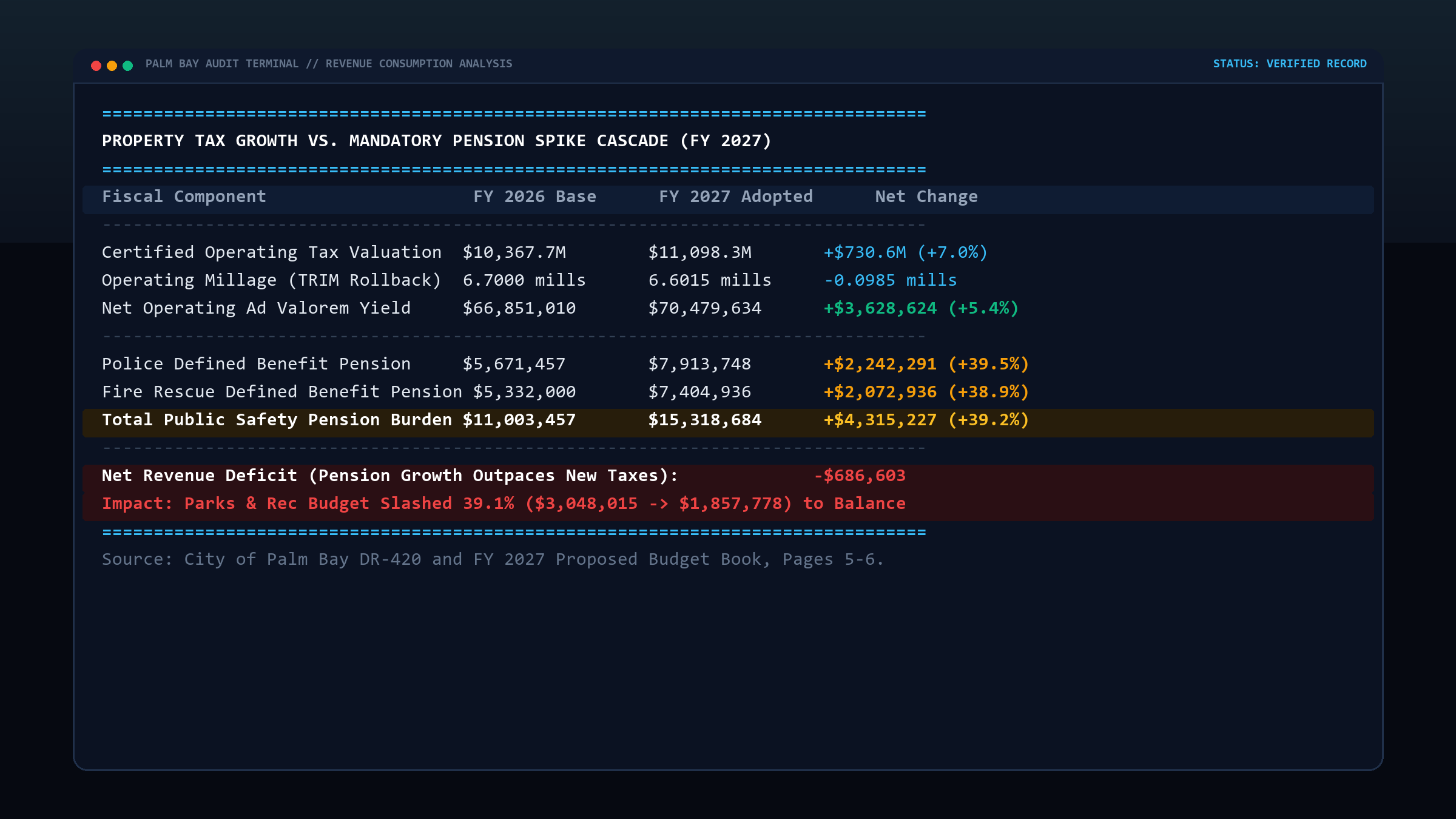
To absorb that fixed increase while maintaining the rolled-back tax rate, administration enacted sharp operational reductions in community services.
On Page 6 of the budget book, General Fund operating appropriations for the Parks and Recreation Department were slashed by 39.1 percent, plummeting from $3,048,015 in FY 2026 down to $1,857,778 for FY 2027.
The Palm Bay Aquatic Center narrowly escaped immediate closure through a targeted budget reallocation. Council defunded its $136,000 annual contract for Flock Safety automated license plate readers, shifting that exact sum into a dedicated General Fund contingency line (Account 001-9010-519.56-01).
That bridge funding keeps the municipal pool operational through November 2026. At that point, operations will pause under a caretaker maintenance freeze until February 2027, giving municipal staff and civic groups a four-month window to negotiate third-party operating partnerships.
Dais Scenarios: Four Paths for Wednesday Night
When Mayor Rob Medina opens Public Hearing Item 1 on Ordinance 2026-38 for second and final reading, Council will face four distinct choices to resolve the disconnect between the killed utility rate hikes and the $457.3 million budget:
- Scenario 1: Adopt the Budget as Written. Council could vote to approve Ordinance 2026-38 and Exhibit “A” without alterations. This would officially enact a budget containing a $5.18 million paper revenue deficit in Fund 421, effectively punting the problem into the fiscal year and forcing administration to implement mid-year emergency budget freezes or draw down reserves without advance planning.
- Scenario 2: Amend Exhibit “A” with an Undesignated Reserve Draw. Council could introduce an amendment from the dais directing Finance staff to balance Fund 421 by drawing $5.18 million directly from the Utilities Undesignated Fund Balance. While this would balance the fund on paper, it accelerates the depletion of cash reserves required to maintain the system’s bond rating.
- Scenario 3: Mandate Operational and Capital Deferrals. Council could direct the City Manager to identify $5.18 million in immediate expenditure cuts within utility operations and capital outlay, matching authorized spending to the actual cash collections expected under frozen rates.
- Scenario 4: Reconsider Utility Rates. Council could reopen discussion on utility rates, directing staff to return with an adjusted, smaller rate schedule or a phased implementation plan that preserves debt service coverage without enacting the full Stantec increase.
Council members cannot avoid the issue. The numbers in Exhibit “A” do not match the recorded roll-call votes from September 9.
Procedural Roadmap: How the Meeting Will Unfold
Special Council Meeting 2026-26 is structured to follow Florida statutory requirements for final budget adoption, moving methodically from staff presentations to public testimony and recorded roll-call votes.
The proceedings will advance through the following sequence:
- Call to Order and Roll Call: Scheduled for 6:00 PM in Council Chambers.
- Public Hearing on Tax Rates and Budget Presentation: Acting Chief Financial Officer Ruth Chapman and City Manager Matthew Morton will present the final FY 2027 budget summary, review changes since July 31, and open the floor to public comment.
- Business Section (Fee Resolutions): Council will vote sequentially on Resolutions 2026-14 through 2026-19, formally enacting municipal fee schedules for fire, recreation, building, impact fees, land development, and miscellaneous services.
- Resolution 2026-20 (Classification and Pay Plans): Enacting authorized employee compensation scales and the municipal Position Control Plan for FY 2027 across all 16 departments.
- Resolution 2026-21 (Five-Year CIP): Enacting the FY 2027 through FY 2031 Capital Improvements Program.
- Resolution 2026-22 (Final Millage Rates): Recorded roll-call vote adopting the operating millage of 6.6015 mills and voted debt millage of 0.9385 mills. Under Florida law, millage must be formally adopted before the budget ordinance is enacted.
- Departmental Training and Travel (Item 10): Consideration of the master travel schedule for municipal leadership.
- Public Hearing on Ordinance 2026-38 (Final Budget Adoption): Second and final reading of the ordinance adopting the FY 2027 Annual Operating Budget of $457,286,978, followed by public comment and the final deciding vote of the budget cycle.
Wednesday night represents the final opportunity for Palm Bay residents to address their elected officials before property tax rates and departmental spending plans become legally binding on October 1.
The hearing will be broadcast live on the city website and YouTube channel, and held in person at City Hall Council Chambers, 120 Malabar Road SE. Public comments will be accepted on each public hearing item before votes are cast.