VIERA, FL (The Palm Bayer) — The Brevard County School Board meets twice on Tuesday, October 6: a 1:00 PM work session and a 5:30 PM regular meeting. The item that matters most to Palm Bay parents is on the work session agenda, and the packet gives it exactly one line: a presentation of Pineapple Cove Classical Academy’s High-Performing Replication Application for a new campus at Emerald Lakes, in southeast Palm Bay. No backup pages are attached.
That single line lands against years of friction between the city and the Pineapple Cove network, most of it centered on a pickup line in the Lockmar Estates neighborhood. What the board hears Tuesday, and what the city demands before a shovel moves in Emerald Lakes, will determine whether southeast Palm Bay gets a new school or a new traffic fight.
This article is drawn from the two agenda packets except where labeled. The Pineapple Cove history below is background from city records and prior reporting, not from the October 6 packet.
Background: two Pineapple Coves, and the Lockmar fight
Pineapple Cove is two legally distinct entities, and confusing them is the oldest mistake in this story. Pineapple Cove Academy is a private commercial childcare business founded in 2006 by John Moran and Beth Scott; its original center at 1785 Eldron Blvd SE in Bayside Lakes has had a routine, low-friction commercial relationship with the city for twenty years. Pineapple Cove Classical Academy is a network of tuition-free public charter schools affiliated with Hillsdale College’s classical model and managed by Classical Education Management LLC. It is the charter network that has generated the friction.
The flagship charter campus opened in fall 2015 at 6162 Minton Rd NW, south of Malabar Road, and has grown into a K-12 facility. Its recurring business before the city is the annual School Resource Officer agreement, through which Palm Bay police staff the campus on off-duty detail. Dismissal traffic on Minton Road, near Bayside High, regularly requires police direction at the school’s ingress and egress points. Founder John Moran has also pursued an aquatic and recreation complex adjacent to the campus, with an Olympic-size pool and splash park, through city planning review.
The flashpoint is the second charter campus, PCCA at Lockmar, which opened in fall 2022 at 720 Emerson Dr NE in the former Covenant Christian School building. Enrollment is roughly 800 students. The property’s on-site vehicle loop holds about 80 cars. The daily afternoon pickup peak runs 250 to 270 vehicles. The arithmetic has not changed in four years: 170 to 190 cars overflow into the Lockmar Estates neighborhood, down Nesbitt Street NE, Penita Street, Hearst Road, and Emerson Drive NE, for 90 to 120 minutes every school afternoon.
Residents have packed council chambers for years with the consequences: subdivision streets chewed up by thousands of added vehicle-miles, blocked driveways, idling parents across private property, and emergency access narrowed to a single lane. The institutional response has been a jurisdictional impasse. City administration has maintained it has no code provisions to act once a site plan is approved and that charter oversight belongs to Brevard Public Schools. The district has held that off-site queues on municipal roads are a municipal police and right-of-way matter. In 2023, when PCCA sought to expand onto adjacent land near the Dollar General on Emerson Drive, neighborhood opposition froze the effort; the mayor stated publicly the city would entertain no rezoning until the existing parent loop was fixed.
Council-directed mitigation has cycled through staging parents in the adjacent church lot, “Do Not Block Driveway” signage, and a proposed taxpayer-funded $240,000 right-turn deceleration lane on Emerson Drive. Residents argue the measures fail for lack of mandatory enforcement by school administration, and they have sharply criticized the deployment of on-duty city police to direct a private charter operator’s traffic, pointing to a June 2026 action by Cooper City against another charter operator as precedent for stronger measures. This year brought escalations: in late August, a district school bus was observed driving into the oncoming lane on Nesbitt Street to bypass the gridlocked parent line, and in early September a resident trying to back out of her own driveway was admonished by officers, fueling allegations of inverted enforcement in which homeowners face scrutiny while the blocking line operates with de facto immunity.
Two more PCCA campuses sit just across the boundary in West Melbourne, on Minton Road and Dairy Road, drawing Palm Bay students and feeding the same Minton corridor.
That is the record the Emerald Lakes application walks into. The question for the board, and for the city’s development review, is whether a new campus in one of Palm Bay’s fastest-growing districts will be required to build binding, multi-lane, on-site stacking and fund private traffic details before opening, or whether the Lockmar pattern repeats on new roads. For Palm Bay parents, the stakes are concrete either way: a new enrollment option in southeast Palm Bay, and a development decision that will shape their commutes for a decade.
The Gale contract comes back on consent
Item 23 asks the board to approve a $68,457.34 sole-source database agreement with Gale, a Cengage company, for the district’s resource library system. The packet lists the prior-year price at $65,211.71 and describes the increase as approximately six percent. The arithmetic comes to about 4.98 percent.
What the item summary does not mention is September 22. At that meeting, the board denied the initial motion on this agreement 0-5, with Campbell, Susin, Thomas, Trent, and Wright all voting nay. A subsequent motion to postpone, made by Campbell and seconded by Wright, carried 5-0 with reconsideration set for October 6. The October 6 discussion summary attached to the item contains no reference to September 22, no reference to a postponement, rejection, reconsideration, or the 0-5 vote.
Whether the item stays on consent or gets pulled for individual discussion is a procedural observation, not a packet fact: placing an agreement on the consent agenda after a 0-5 recorded rejection is an aggressive administrative move, and under standard parliamentary practice a failed item would normally return as an individual action or discussion item so members can state the basis for any changed position. If Campbell (District 5) or Wright (District 1) pull it, the administration will have to justify the sole-source renewal in public.
Rockledge design money funds Viera fields
Item 36 is a $213,949 design task order with Gale Associates for baseball and softball field improvements at Viera High: a $208,949 design proposal plus $5,000 in administration and permitting. The funding narrative is explicit. The project carries a $167,121 Viera balance, and staff are moving $42,450 from Rockledge High’s stadium relocation design because, in the packet’s words, that project is “not ready for design or construction at this time.”
The packet’s financial table breaks the funding into two budgeted lines, both marked Budgeted: Yes, under Fund 375, Cost Center 1171, Function 7400. The first line is $208,949 on Project 007956, Object 674. The second is $5,000 on Projects 007956 and 305963, Objects 674/676. The narrative sources total $209,571 ($167,121 Viera plus $42,450 Rockledge), which covers the $208,949 design fee with $622 to spare, with the $5,000 admin/permitting line (Projects 007956/305963, Fund 375) covering the remaining $4,378. The packet shows no unfunded project here.
What the packet shows is capital movement, and Palm Bay parents watching it will ask the obvious question: while $42,450 in design capital leaves Rockledge for Viera’s fields, what does the facilities plan hold for their own zoned schools in the south county? The packet’s capital docket touches two schools in the entire county, and neither is in Palm Bay: Viera High and Rockledge High. (That geographic reading is broadsheet context, not packet text; the packet gives the facility names and the “not ready” quote.)
The fiscal backdrop: a health plan running at 118 percent
The September 15 workshop minutes, up for approval as Item 12, put the district’s self-insured health plan at a 118 percent cost ratio: $9.7 million over budget year to date, with projected 2026 costs of $99.6 million running roughly $7 million over budget. Medical claims are up 21 percent, prescription claims up 16 percent, and high-cost claimants over $100,000 total $20.6 million, about one-third of all claims.
The cost-containment response, presented at the workshop under “Proposed Plan Design Changes,” includes a $50-per-pay-period tobacco surcharge effective January 2027, brand-name drug copays rising from $50 to $75, and wellness points tied to deductibles beginning in 2028. These are proposals, not enacted policy: the minutes list them under “Board Action Items: Select the 2027 health plan design,” and the record shows no formal vote adopting them. Open enrollment cannot assess a $50 biweekly surcharge without one.
Item 25, the five-year award to Standard Insurance for life, AD&D, and disability coverage through December 31, 2031, locks the district-paid basic life rate flat at $0.09 per $1,000 while the negotiated communications fund jumps from $50,000 to $170,000. On the employee-paid side, voluntary short-term disability rates rise 15 percent while critical illness rates fall 33.2 percent.
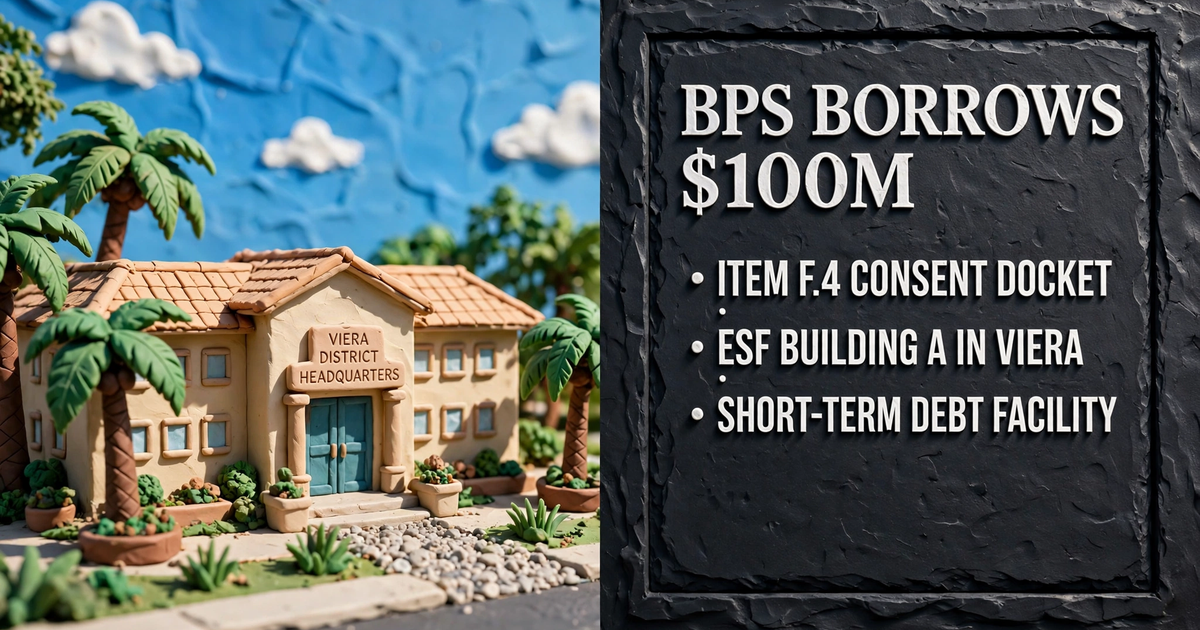
The same minutes document the September 22 vote to execute a $100 million Tax Anticipation Note, which passed 4-1 with Wright dissenting. The people absorbing the proposed surcharges are the teachers and staff in Palm Bay classrooms. Whether the trust’s reserves survive another year at a 118 percent loss ratio before the Cigna renewal forces larger payroll deductions or plan changes is a forecast, not a packet fact; the packet facts are the ratios, the overage, and the proposals awaiting a vote.
Athletic authority: a new coordinator and a rewritten transfer rule
Item 20 is a new job description for a Student Activities Coordinator, the district’s standardized athletic director position. The authorization form shows a requested agenda date of September 22, 2026; the position did not appear in the September 22 minutes (that night’s Item 9 was the Community Teacher position). Among its duties: the coordinator must “approve all purchase orders (athletic budget and internal club accounts)” and “initiate all home contest contracts” (p. 65).
As a matter of reporter analysis rather than packet text, the practical effect is to centralize fiscal sign-off that previously sat closer to individual schools: one administrator’s signature over team budgets and booster-adjacent club accounts alike. For Palm Bay households, that signature sits directly over their kids’ team funds.
Pair that with the work session’s Policy 2431.01 redlines. The policy sets out seven exceptions under which a transfer student may play the same sport at two schools in the same year: a dependent child of active-duty military personnel moving under orders, a foster care placement, a full and complete move under FHSAA policy, a district reassignment not tied to discipline or a parent request, formal admission from a waitlist within the first 20 school days, a court-ordered custody change (or the serious illness or death of a custodial parent), and good cause approved by the governing athletic organization’s executive director. The redlines strike local principal “good cause” determinations and insert a mandatory 14-day eligibility determination clock, routing appeals to the governing organization under its own bylaws. The practical effect is to move final transfer-eligibility authority out of the school board’s hands and into the external athletic association’s. For families with student-athletes, that is the rulebook that decides who plays Friday night.
Policy 2431 itself requires annual athletic activity fees, with calculations, to be published online by July 1. The packet’s SB 538 summary ties the statute to eligibility, medical examinations, insurance, recordkeeping, activity fees, and transportation. The packet draws no connection between SB 538 and booster-funded coaching compensation, and none should be inferred. Policy 9215, covering school support organizations including boosters, stands on its own with no SB 538 citation.
The 23-policy NEOLA package follows a fixed schedule: work session review October 6, Rule Development and first public hearing October 27, final public hearing December 8.
Cuyler: three acres go to market
Item 35 authorizes the superintendent to market approximately three acres along the northern portion of the historic Cuyler School site’s 13.73-acre parcel for potential sale. The authorization is the first step only. Any surplus declaration, boundary survey, lot split, and purchase contract must return to the board. The packet names no buyer, no demolition plan, and no timeline.
Money items, in order
Item 32 renews the external auditing contract with Forvis Mazars under RFP 21-499-P-KR at $135,000 per year for the fiscal years ending June 30, 2026 and June 30, 2027. That is 3.85 percent over the immediately prior $130,000 pricing and 8 percent over the original $125,000 pricing, carried as a budgeted operational expenditure in Financial Services.
Item 33 amends the Bailey Education Group professional development agreement by $94,000, bringing the total to $266,000 under a sole-source justification. The amendment adds Saturn Elementary to the existing coaching work at Endeavour and Golfview, runs September 11, 2026 through June 30, 2027, and is coded to Special Revenue, Fund 422.
Item 22 renews Title IX coordination services with ICS LLC at $30,000, a $90,000 total reference including the base agreement, running through November 14, 2027. The backup states the renewal is in anticipation of an increase in cases tied to definitional changes expanding what qualifies as Title IX.
Item 27 standardizes automated external defibrillators on the Zoll AED 3 at $80,000 to $100,000, phasing out Powerheart G5 units. Item 26 records Spherion’s termination of its temporary staffing contract effective October 2, 2026, citing a retirement. Item 31 renews photography services across five vendors (Cady, Dean Stewart, Lifetouch, Strawbridge, TSS); the packet contains no commission, rebate, or revenue-share language. Item 24 renews the multi-vendor screen-printed t-shirt contract through October 2029. Item 21 disposes of surplus property valued at $209,204.32. Item 29 piggybacks motor oils and lubricants through July 23, 2027; Item 30 extends electronic IT disposal, a revenue-generating e-waste contract, through January 24, 2028. Item 28 extends the continuing casework and cabinet installation contract.
Item 34 is the five-year Local Mitigation Strategy update with Brevard County Emergency Management, submitted to FEMA for review and approval. (FEMA grant eligibility effects are a matter of external statute, not packet text.)
Item 37 dedicates a Tract P sidewalk easement at Viera Elementary from The Viera Company. Items 38 and 39 are student travel: Melbourne High’s IB Theatre trip to New York City at $1,200 per student, and Rockledge High’s JROTC Raider Challenge trip to Fort Knox, Kentucky at $14,000 total, Army-sponsored and fundraiser-supported.
Work session: the rest of the docket
Beyond the Pineapple Cove presentation and the policy package, the work session includes a transportation management system item carrying a blank summary sheet apart from its item and contact fields; Chief Operating Officer Rachad Wilson is listed to deliver an oral presentation on the conversion. The SB 538 board discussion item likewise has no attached backup. A discussion of Policy 0169.1 follows the September 22 consensus to broadcast non-agenda public comment at the start of official meeting livestreams, with a 3-minute and 2-minute speaker structure; that was board discussion and consensus, not adopted policy.
Items 6 through 8 are proclamations and recognitions, including Breast Cancer Awareness Month and Parents’ Rights Month. Item 13 covers student expulsions. Item 14 is the August Head Start report: 624 children enrolled, 93.3 percent attendance, 10.13 percent children with disabilities. Items 18 and 19 are routine personnel staffing. Item 11 is the School Board Attorney evaluation, composite score 93.55, containing a specific board directive: “The board discussed the need to step in at meetings before asked by board members.”
What to watch (reporter analysis, not packet fact)
Four trajectories are worth tracking against these packets. First, Emerald Lakes: the replication presentation is the first public step, and the Lockmar record gives the board and the city a preview of the exact failure mode to contract against. Whether binding on-site stacking reservoirs and privately funded traffic details are required up front, before approval, is the decision that determines whether southeast Palm Bay gets a school or a sequel.
Second, athletic centralization: purchase-order authority moving to a standardized coordinator, transfer appeals moving to the external athletic association, and capital design dollars moving from Rockledge to Viera all point the same direction. Whether that produces friction with booster organizations or with the central-Brevard attendance zones is the open question for the October 27 and December 8 policy hearings.
Third, the health trust: a 118 percent loss ratio with $9.7 million in year-to-date overages is not absorbable indefinitely, and the proposed surcharges suggest the administration is already pricing in employee cost transfers ahead of the Cigna renewal. The formal vote has not happened yet; its scheduling is the near-term tell.
Fourth, procedure: the Gale re-entry tests whether a 0-5 rejection followed by a unanimous postponement returns as a quiet consent item or as the public discussion standard practice would expect.